

Is Hidden Waste Killing Your Veneer Dryer’s Real Capacity?
When a Malaysian veneer mill owner invested in a brand-new 100m³/day wood veneer dryer last year, he expected the machine to slash his production bottlenecks. Six months in, though, the unit struggled to hit 60m³ of dried stock daily—well below its rated output. His first instinct was to blame the equipment supplier, but a week-long audit revealed a different culprit: hidden, unmeasured waste across every stage of his drying process. For mill operators worldwide, underperformance of a veneer drying machine is rarely a single, obvious failure. More often, it is the sum of small, overlooked inefficiencies that quietly eat away at capacity, turning a high-investment asset into a chronic underperformer.
The first and most overlooked source of lost capacity sits upstream, at the peeling lathe. Most operators check the surface moisture of fresh wood veneers, but few account for the “moisture tax” hidden inside the log. For example, birch heartwood can hold 130% moisture content by weight, while sapwood from the same log sits at just 70%. When these mixed sheets enter a veneer drying machine, operators must slow the line to ensure the high-moisture heartwood sheets dry fully—even though the sapwood would dry faster at higher speeds. Even small variations in veneer thickness play a bigger role than most realize: a 0.2mm deviation in sheet thickness adds 15% to required drying time, as heat takes longer to penetrate thicker sections. Worse, torn or crushed veneers—common when lathe blades are dull—disrupt airflow patterns inside the wood veneer dryer, creating unpredictable dry/wet spots that force further speed reductions to avoid quality failures.
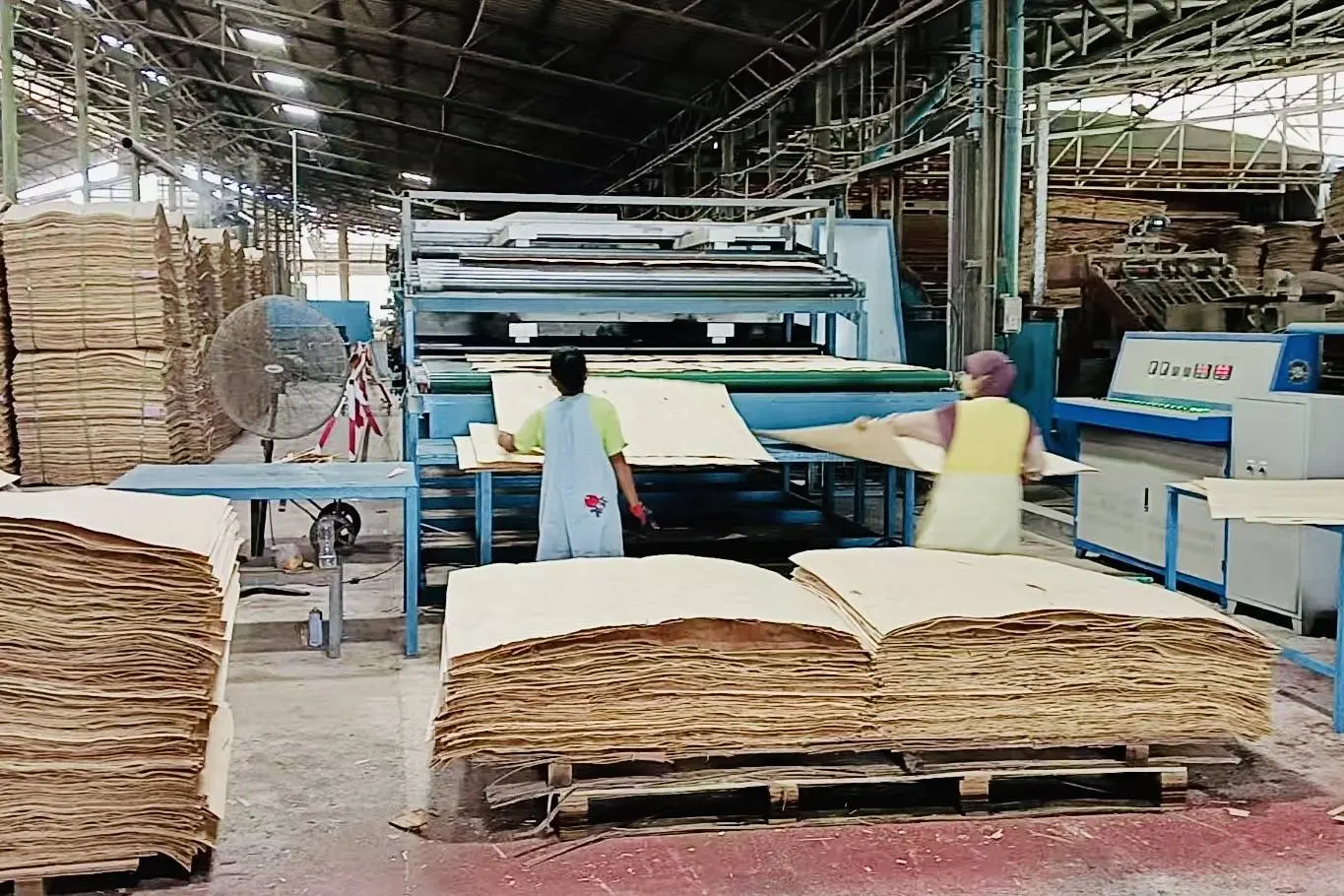
Feeding irregularities are another silent capacity killer. Many mills rely on semi-automated loading systems that create “pulse gaps”: short, 1–2 minute stretches where no veneers enter the dryer between batches. Over an 8-hour shift, these gaps add up to nearly an hour of idle runtime—translating to 8–10% of total daily capacity lost before the dryer even starts working. Double-feeding, where two sheets slip into the veneer drying machine at once, is equally damaging. Beyond jamming risks, overlapping sheets dry unevenly, forcing operators to pull wet stock for re-drying. Re-drying uses 1.5x the energy of initial drying, effectively cutting the dryer’s effective capacity by a third for every batch of defective stock. For mills using Shine flip-type dryers or roller systems, even minor misalignments in the infeed conveyor can skew sheet placement, creating “dead lanes” where airflow bypasses veneers entirely.
Thermal inefficiency is rarely as obvious as a broken burner. Instead, it hides in small, cumulative losses. A common issue is unmonitored temperature drop across the drying chamber: if inlet air hits 130°C but exit air stays above 80°C, up to 30% of heat energy is wasted heating incoming cold veneers rather than driving off moisture. Tiny gaps in the dryer’s insulation seals—often caused by aging silicone gaskets—let 10–15% of heat escape without ever touching the wood veneers. Even well-maintained heat exchangers lose efficiency over time: a 2mm layer of dust on exchanger fins cuts heat transfer by 20%, forcing operators to slow the veneer drying machine to compensate. The fan system, the heart of any wood veneer dryer, is another frequent source of hidden loss. Axial fan blades worn down by just 5mm reduce airflow by 15%, creating stagnant zones where moisture lingers. Most mills only replace fans once they fail completely, missing months of slow, steady capacity erosion beforehand.
Exhaust system mismanagement is a final, often-overlooked driver of underperformance. A wood veneer dryer must maintain a delicate balance between removing moist air and retaining heat—but many operators treat exhaust as a set-it-and-forget-it system. During rainy seasons or in humid coastal regions, ambient humidity can climb to 90%, saturating the air inside the dryer if exhaust fans are not sped up or fresh air intake reduced. Stagnant moist air forms a “humidity blanket” above the veneers, slashing evaporation rates by up to 40%. Worse, clogged exhaust filters or undersized ductwork trap moist air inside the chamber, forcing the veneer drying machine to run longer to hit target moisture levels. Regular exhaust audits—measuring humidity at both the inlet and outlet—can identify these issues before they cut into daily output.

Human factors and lax maintenance compound these technical issues. Many operators rely on “rule of thumb” adjustments rather than data-driven parameters: speeding up the dryer on hot summer days, slowing it down in winter, without accounting for differences between wood species or veneer thickness. A 1.5mm poplar veneer dries 20% faster than a 1.5mm eucalyptus sheet, but few mills maintain a lookup table to adjust speeds accordingly. Preventative maintenance gaps are equally costly: a conveyor chain loose by just 1cm adds 10% to running resistance, forcing the motor to draw more power while slowing the line. Most mills wait until chains jump or rollers seize before scheduling repairs, losing weeks of incremental capacity in the meantime. For a veneer drying machine, even 30 minutes of unplanned downtime per day adds up to 180 hours of lost runtime per year—enough to produce 1,500m³ of extra dried veneers annually.
Finally, the wood veneer dryer is only as efficient as the rest of the production line. The “weak link” effect means a dryer rated for 100m³/day will never exceed the capacity of the slowest upstream or downstream process. If the peeling lathe only produces 70m³ of green veneers daily, the dryer will sit idle 30% of the time. If the stacking system at the dryer’s outlet can only handle 80m³/hour, the entire veneer drying machine must slow to match. Even post-drying storage plays a role: dried wood veneers stored in unconditioned warehouses with 70%+ humidity will reabsorb moisture, requiring re-drying that wastes both time and energy. Holistic line balancing—ensuring every stage from peeling to stacking matches the dryer’s rated capacity—is often the fastest way to unlock hidden output.
The Malaysian mill owner mentioned earlier fixed his capacity issues without buying a single new machine. By auditing raw material variability, tightening infeed consistency, sealing insulation gaps, calibrating exhaust fans, and aligning his production line, he boosted his wood veneer dryer’s output to 92m³/day in just four weeks. For most operators, underperformance of a veneer drying machine is not a sign of faulty equipment—it is a signal that small, hidden inefficiencies are adding up. Systematic audits, data-driven adjustments, and proactive maintenance can unlock 20–30% more capacity from existing assets, turning a chronic underperformer into a profit driver. In an industry where margins are thin, that hidden capacity is often the difference between a struggling mill and a thriving one.