

Breaking Limits:Engineering Beauty with Curved Wood
The Rise of Curved Plywood
In the evolving landscape of modern manufacturing and design, materials are no longer judged solely on their strength or cost, but increasingly on their adaptability, sustainability, and aesthetic potential. One material currently reshaping industries from high-end furniture to marine engineering is curved plywood, also widely known as bent plywood, bendable plywood, or curved wood. This engineered material, created by bonding multiple layers of thin wood veneers with adhesive and shaping them into molds under heat and pressure—either hot or cold—is rapidly becoming the go-to solution for designers and manufacturers aiming to merge organic beauty with structural reliability.
The driving force behind the surging popularity of curved plywood lies in its exceptional plasticity and design freedom. Unlike traditional solid wood, which is limited by grain direction and prone to cracking when forced into tight radii, curved plywood can be molded into complex geometries such as full circles, spirals, and intricate three-dimensional forms with very small curvature radii. This breaks through the geometric limitations of conventional wood bending, allowing architects and product designers to realize fluid, ergonomic, and avant-garde shapes that were once difficult or impossible to achieve. Whether it is a seamlessly curving chair shell that cradles the human body or a sweeping, wave-like interior wall panel in a luxury hotel lobby, curved plywood delivers a level of formal freedom that elevates both function and artistic expression.
Beyond aesthetics, the material offers outstanding structural integrity and stability, rooted in its cross-laminated veneer construction. By arranging the thin wood layers so that the grain of each layer alternates direction, the resulting panel achieves superior resistance to bending, shearing, and compression—often enhancing mechanical strength by over 15% compared to single-piece wood or poorly laminated alternatives. This cross-fiber arrangement also minimizes common wood defects such as warping, cracking, splitting, or spring-back over time. Once cured in the mold, the material retains its shape firmly, ensuring long-term dimensional stability even under varying humidity and load conditions. This makes curved plywood especially valuable in applications where precision and durability are critical, such as musical instrument soundboards, vehicle interiors, and load-bearing architectural elements.
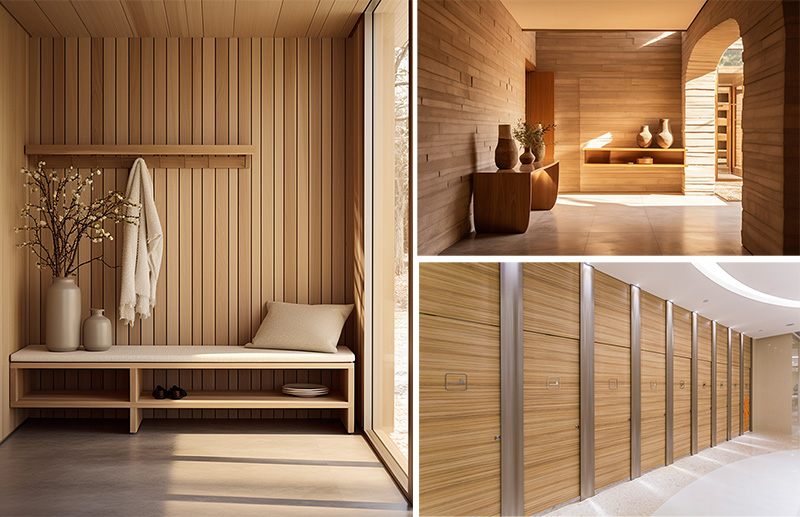
Resource efficiency is another major advantage propelling curved plywood into the spotlight of sustainable manufacturing. Traditional solid wood bending typically yields wood utilization rates of only about 25% to 45%, as large portions of timber are cut away or lost to defects and breakage during steaming and forming. In contrast, curved plywood production maximizes material usage, often achieving utilization rates above 75%. Thin veneers can be efficiently spliced, joined end-to-end, or even produced from off-cuts and lower-grade timber, with high-quality face veneers ensuring a premium surface appearance. This approach significantly reduces the demand for large-diameter hardwood logs, supports responsible forestry, and aligns with circular economy principles by turning more of the tree into usable product. For companies facing rising raw material costs and tightening environmental regulations, this efficiency is both an ecological and economic win.
The production process itself is relatively straightforward and highly amenable to mechanization and mass production. After selecting and drying suitable veneers—such as beech, birch, poplar, or eucalyptus—the sheets are coated with adhesive, typically a durable and increasingly eco-friendly resin such as E0 or E1 low-formaldehyde glue. The layered pack is then placed into a custom mold and subjected to controlled heat and pressure, curing the adhesive while locking in the curved shape. Following demolding, the parts may undergo a brief conditioning period—often called “resting” or “curing”—before trimming, sanding, and finishing. Because the core technique does not require the complex softening, steaming, or steam-bending fixtures associated with solid wood, manufacturers benefit from shorter lead times, reduced labor intensity, and more consistent output quality. This scalability has made curved plywood a staple in large furniture factories, interior fit-out contractors, and specialized component suppliers serving global brands.
Environmental considerations further strengthen the case for curved plywood. In addition to high wood utilization, many producers now employ low-emission adhesives and water-based finishes that comply with green building standards and indoor air quality certifications. The ability to substitute endangered or slow-growing hardwoods with fast-growing veneer species, combined with the longevity and repairability of well-made plywood components, contributes to a lower life-cycle environmental impact. Moreover, because curved plywood parts can be designed as modular or knock-down units, they simplify packaging, reduce shipping volume, and facilitate easier assembly and disassembly—benefits that resonate strongly in today’s logistics-conscious and sustainability-driven markets.
Application-wise, curved plywood spans a remarkably broad spectrum. In furniture manufacturing, it is the material behind iconic ergonomic chairs, sculptural tables, rounded cabinetry, and continuous-profile sofas that balance comfort with visual lightness. In architectural and interior design, it enables seamless curved walls, acoustic ceiling clouds, reception desks with fluid edges, and decorative columns that would be prohibitively expensive or technically daunting in solid wood or stone. The transport sector relies on it for lightweight yet sturdy interior panels in ships, high-speed train carriages, recreational vehicles, and aircraft cabins, where saving weight without sacrificing strength is paramount. Even the musical instrument industry values curved plywood for instrument tops and backs that demand both tonal responsiveness and structural consistency.
As design trends continue to favor softer lines, biophilic forms, and customized spatial experiences, curved plywood stands out as a material that reconciles creative ambition with industrial practicality. Its combination of high formability, robust performance, resource efficiency, streamlined processing, and environmental compatibility positions it not merely as an alternative to solid wood, but as a forward-looking engineered solution for the demands of 21st-century making. For industries navigating the dual pressures of aesthetic differentiation and sustainable operations, curved plywood offers a compelling, proven, and continuously evolving answer.