

Engineered Veneer Drying Explained
In the world of decorative panels and furniture manufacturing, engineered veneer (also called reconstituted veneer or technical veneer) has become a superstar. By slicing thin layers from dyed, and glued wood blocks, manufacturers can create consistent, exotic, and even custom wood grains that natural timber cannot match. But a question we frequently hear from plywood mills and veneer processors is: Does engineered veneer actually need to be dried? The short answer is a resounding yes—and the drying process is far more delicate than you might think.
Many assume that because engineered veneer is a man‑made product, it can skip the traditional drying step. In reality, freshly peeled or sliced engineered veneer carries a very high moisture content, often between 40% and 60%, sometimes even higher. This is due to the water‑based dyes, bleaching agents, and glues used during its production. If this moisture is not properly removed, the veneer will cause endless headaches down the line.
Why Engineered Veneer Must Be Dried
1. Prevent Bonding Failure
When veneer with moisture above 12% is laminated onto MDF, plywood, or solid wood substrates, the excess water dilutes the adhesive. This leads to open joints, blistering, or delamination after pressing. A properly dried engineered veneer, with final moisture content (MC) stabilized at 8%–10%, ensures a strong, lasting bond.
2. Stop Mold, Discoloration, and Color Migration
Engineered veneers are soaked in chemical dyes and bleaching solutions. High humidity creates the perfect breeding ground for mold and bacteria. Worse, uneven drying can cause the dyes to migrate, creating ugly blotches or faded patches. Controlled drying locks in the intended color and prevents microbial growth.
3. Improve Handling and Processing
Veneer that is too wet is limp and deforms easily during cutting, splicing, or edge banding. Over‑dried veneer becomes brittle and cracks. The sweet spot—achieved only through precision drying—gives the veneer just enough flexibility for flawless machining while remaining dimensionally stable.
Unique Drying Challenges
Drying engineered veneer is not the same as drying ordinary rotary‑cut veneer. Its extreme thinness (typically 0.15–0.6 mm) and composite structure introduce four major challenges:
1. Extreme Thinness & Curling: At less than half a millimeter, the veneer can instantly curl into a tube when exposed to uneven heat or airflow. This can jam equipment and ruin entire batches.
2. Dye Layer Sensitivity: The colored surface reacts badly to high temperatures, which can cause fading, darkening, or color shift. Strict low‑temperature control is mandatory.
Adhesive Heat Limit: The inner plies of engineered veneer are glued together with urea‑formaldehyde or phenolic resins. Excessive heat softens these glues, causing the veneer to delaminate from within.
3. Internal Stress & Warping: Because the sheet is thin and dense, moisture evaporates rapidly from the surface while the core remains wet. This creates differential shrinkage, leading to waves, buckles, or twisted sheets that are impossible to lay flat during lamination.
Precision Drying Process Parameters
To overcome these hurdles, a dedicated veneer drying machine must be configured with the following parameters:
* Temperature: Keep the entire cycle between 50–75°C (122–167°F). Never exceed 80°C. A typical profile includes a preheating zone at 40–50°C, a constant‑rate drying zone at 60–70°C, and a balancing zone at 50–60°C.
* Air Speed: Use very gentle, uniform airflow of 0.3–1.0 m/s. High‑velocity air will lift and crumple the thin sheets. Modern dryers employ perforated air plates or dense, evenly spaced nozzles to distribute air without creating hot spots or turbulent gusts.
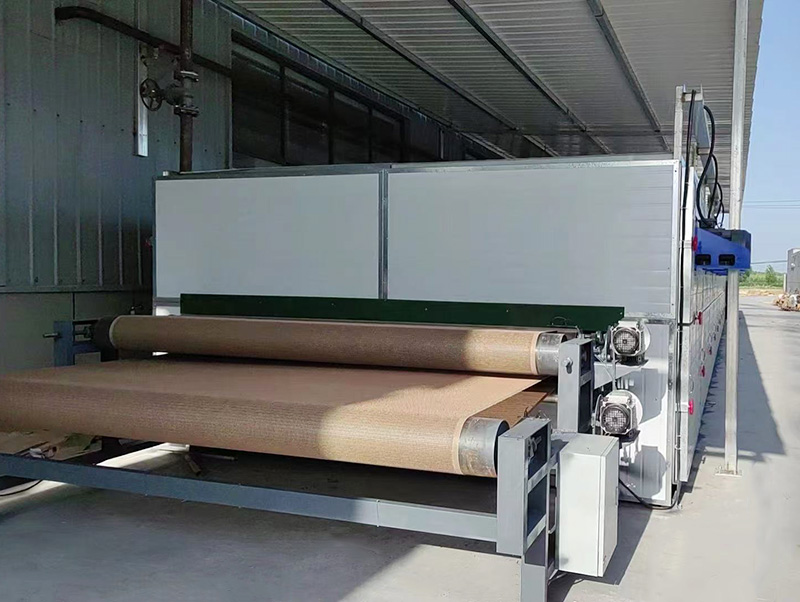
* Conveyance Method: The veneer must be physically held flat during drying. This is where a mesh belt veneer dryer proves indispensable. A fine‑hole stainless steel mesh belt or a Teflon‑coated breathable belt gently presses the veneer against a heated surface, preventing curling while allowing hot air to circulate. Some high‑end models integrate rubber rollers that simultaneously iron and dry the sheet, delivering a perfectly smooth, flat product.
* Humidity Control: Start with relative humidity around 50%–60% to avoid surface crusting, then gradually increase dehumidification. Sudden moisture removal causes immediate curling.
* Final MC and Conditioning: Target 8%–10% MC. After exiting the dryer, the veneer should cool slowly to room temperature—never be exposed to cold air abruptly. A 12–24 hour conditioning period in a humidity‑controlled room equalizes any residual moisture gradient. Sheets should be stacked with flat, heavy boards on top to prevent post‑drying deformation.
Recommended Drying Equipment
For engineered veneer production lines, we strongly recommend two types of specialized machines:
Mesh Belt Veneer Dryer – Designed specifically for ultra‑thin decorative veneers. It features multi‑zone temperature control, variable‑frequency fans, anti‑stick belt surfaces, and automatic edge‑tracking. The mesh belt applies just enough pressure to keep the veneer flat without leaving imprints. This is the workhorse for 0.2–0.6 mm reconstituted veneers in continuous operation.
Conclusion
Engineered veneer is not a “dry‑free” material. On the contrary, its high initial moisture, extreme thinness, and chemical treatments make drying one of the most critical steps in the entire production chain. Using a conventional high‑heat dryer will only destroy the product. Instead, invest in a purpose‑built veneer drying machine—particularly a mesh belt veneer dryer—that offers precise low‑temperature control, gentle air distribution, and flat‑press conveyance.
For veneer manufacturers and furniture panel producers, mastering this drying process means higher yields, consistent color, superior bonding, and ultimately, a premium product that commands higher prices in the global market.
Are you planning to upgrade your engineered veneer drying line or need a customized solution for your specific veneer thickness and output? Our engineering team designs and supplies complete drying systems tailored to reconstituted veneers, ensuring optimal quality and energy efficiency. Contact us today to discuss your requirements and receive a detailed quotation.