

Veneer Moisture Content: Plywood Production Impact
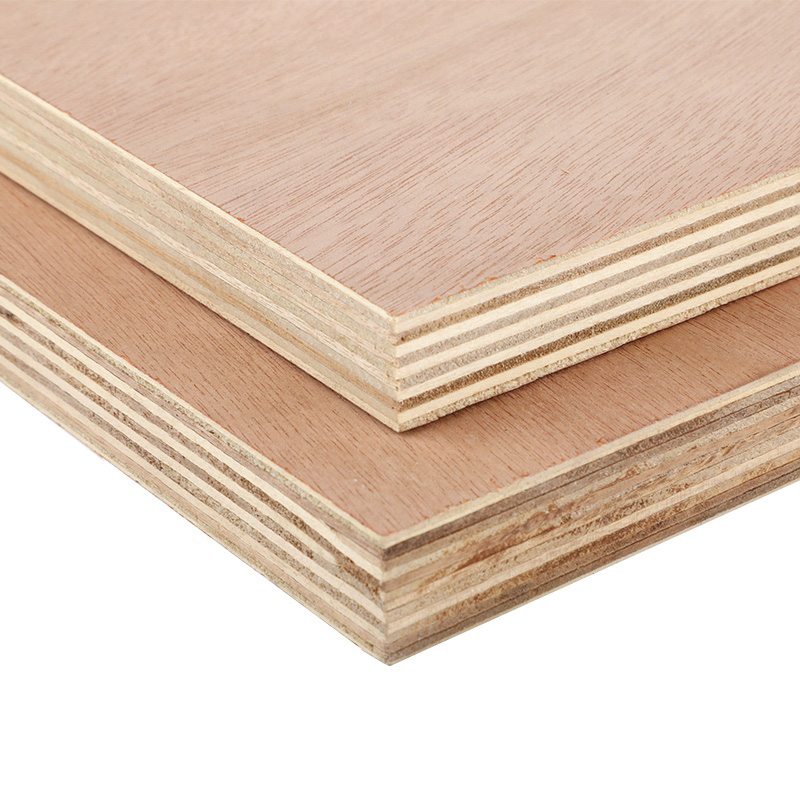
In plywood manufacturing, moisture content (MC) of veneers is arguably the most sensitive and critical process parameter. Industry experience shows that over 70% of quality defects in plywood—such as bubbling, delamination, and warping—can be traced back to improper veneer moisture control. Whether you are a plywood mill owner, a production manager, or a buyer evaluating supplier quality, understanding how veneer MC affects every stage of production is essential for reducing costs and improving product consistency.
This blog breaks down the multi-dimensional impact of veneer moisture content on plywood production, from glue bonding to energy use, and provides practical control guidelines.
1. Impact on Bonding Strength and Glue Quality
The curing of adhesives (urea-formaldehyde, phenol-formaldehyde, MDI, etc.) requires specific temperature and moisture conditions. Both excessively high and low MC disrupt this balance.
When MC is too low (<6%):
Premature curing (pre-cure): During hot pressing, insufficient moisture in the veneer causes the glue line to solidify too quickly, forming a dry, weak film. Bonding strength drops sharply.
Excessive glue penetration: Dry veneer acts like a sponge, absorbing adhesive deep into the wood and leaving a “glue-starved” surface layer. This results in poor adhesion or even open joints.
Surface densification: Over-dried veneer has hardened lignin on the surface, reducing mechanical interlocking with the glue.
When MC is too high (>14%):
Bubbling and delamination: Large amounts of free water turn into steam at 100°C+ during pressing. If steam cannot escape, it accumulates at weak glue lines, causing internal separation and surface bubbles—often fatal defects.
Glue dilution: Excess water dilutes the adhesive, lowering bond strength and sometimes causing “chalking” (incomplete curing).
Extended pressing time: More moisture means more heat is needed for evaporation before the temperature reaches the glue curing point (120–140°C), reducing throughput.
Ideal MC ranges:
Face/back veneers: 8%–10% (slightly lower for surface finish and strong bonding)
Core veneers: 10%–12% (slightly higher to provide steam that promotes glue flow)
Within the same panel, MC variation between layers should be ≤2% to avoid stress imbalance.
2. Impact on Hot Pressing and Energy Consumption
Moisture content directly affects how much energy is needed and how long pressing takes.
MC Condition | Effect on Hot Pressing | Energy Consequence |
|---|---|---|
Too high | Must evaporate large amounts of free water before glue cures | Steam/electricity consumption increases 15%–30%; cycle time extends 20%–40% |
Too low | Heats up fast but glue pre-cures; may need higher temperature | Higher temperature → higher energy use; risk of veneer scorching |
Optimal & uniform | Moisture creates mild steam to aid glue flow, then cures quickly | Shortest pressing cycle, lowest energy cost |
A useful rule of thumb: within the reasonable range, every 1% reduction in veneer MC can shorten hot-press time by about 3%–5%. However, over-drying forces you to add steam or extend dwell time, negating the savings.
3. Impact on Dimensional Stability and Warping
Uneven moisture is a hidden killer of plywood flatness.
MC gradient creates internal stress: If face veneer is at 6% and core at 14%, moisture migrates from core to face after pressing. Upon cooling, the core shrinks more than the face, causing warping or twisting.
Post-installation deformation: Plywood with uneven initial MC will continue to absorb or release moisture at the customer’s site, leading to floor buckling, cabinet door misalignment, or formwork bulging.
Interlayer shear stress: During lay-up, if adjacent veneers have significantly different MC, their shrinkage rates diverge after gluing, generating shear forces that can cause long-term delamination.
4. Impact on Glue Consumption and Cost
Moisture extremes waste adhesive:
Too dry: Glue penetrates too deep → must increase glue spread by 10%–15% to compensate.
Too wet: Glue is diluted → effective solid content drops, requiring more glue or higher-concentration adhesive.
Optimal MC: Glue forms a uniform film with penetration depth of only 0.1–0.3 mm, minimizing consumption.
For example, on a production line making 500 plywood sheets per day, reducing average veneer MC from 15% to 10% can save approximately $200–$500 daily in adhesive costs (depending on glue type), while also cutting bubble-related rejects.
5. Impact on Veneer Handling and Lay-up Efficiency
Over-dried veneers: Become brittle and break easily during handling, pre-pressing, and loading. Thin veneers (<0.6 mm) may be impossible to process without cracks.
Over-wet veneers: Are soft and prone to wrinkling, making it hard to align layers. Edges may not be straight, increasing trimming waste. Wet veneers also tend to stick together, slowing down automatic lay-up lines.
Properly dried veneers: Possess ideal flexibility and elasticity—neither breaking nor wrinkling—allowing faster, more accurate lay-up and better pre-press performance.
6. Moisture Requirements for Different Adhesives
Different glue systems have distinct MC tolerances:
Adhesive Type | Optimal Veneer MC | Reason |
|---|---|---|
Urea-Formaldehyde (UF) | 8%–12% | Sensitive to moisture; high MC causes bubbles, low MC causes pre-cure |
Phenol-Formaldehyde (PF) | 10%–14% | Slower curing, needs more heat/moisture; high water resistance |
Melamine-modified | 8%–11% | Similar to UF but better heat resistance; slightly wider MC range |
MDI (Isocyanate) | 5%–10% | Extremely sensitive to water; moisture reacts with MDI and consumes glue |
Soy/Bio-based glue | 8%–12% | Curing depends on water evaporation; too high risks mold, too low weakens bond |
7. Production Control Best Practices
To maintain optimal MC, implement these measures:
Conditioning after drying: After the dryer, store veneers in a buffer chamber for 12–24 hours to equalize MC (internal variation <2%).
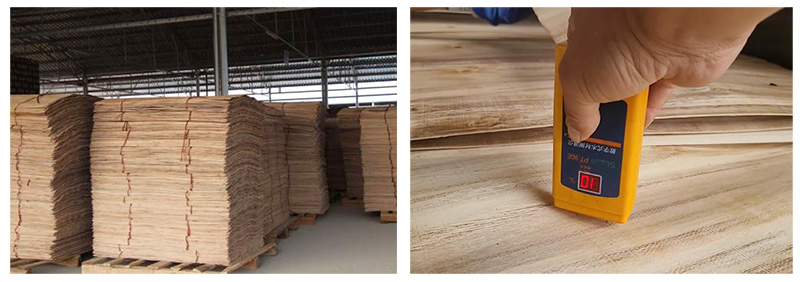
Online moisture meters: Install resistance or microwave sensors before hot pressing. Link data to the dryer’s speed/temperature controls for real-time adjustment.
Differential control for core vs. face: Allow core veneers to be 2%–3% higher in MC than face veneers. During pressing, this slight moisture migration toward the surface actually improves bonding.
Environmental humidity management: Adjust dryer settings and glue solid content according to seasonal humidity changes in the workshop.
Proper stacking: Cover veneer stacks to prevent moisture reabsorption or uneven air-drying before gluing.
Conclusion
Veneer moisture content is the “master switch” of plywood production. When controlled well, you get strong bonding, low energy use, minimal warping, and reduced glue costs. When ignored, you face bubbling, delamination, rejects, and wasted resources. For plywood mills aiming to compete globally, investing in accurate moisture measurement and consistent drying processes is not optional—it’s fundamental.
Are you looking to upgrade your veneer drying line or add online moisture detection to your plywood plant? Our team provides customized solutions for softwood and hardwood veneer drying, helping you hit the optimal MC every time. Contact us today to discuss your production needs and get a detailed proposal.