

A Guide to Choosing the Right Engineered Board
Comparing Plywood, Eco-Board, OSB, and MDF for Your Project
Plywood: The All-Rounder for Stability
Plywood, constructed from multiple thin wood veneers (typically 3-13 layers) glued together with their grains perpendicularly aligned, is a versatile and stable option. Common base woods include poplar and birch.
Core Advantages: Its cross-graining structure significantly enhances dimensional stability, making it highly resistant to warping and cracking. It offers medium-to-high strength, superior to particleboard and MDF, and is flexible enough for curved applications. Its price point is generally moderate, offering good value.
Key Disadvantages: Its environmental friendliness is heavily dependent on the adhesives used; boards with inferior glue can have high formaldehyde emissions, making E0-grade or higher certifications essential. The surface is not inherently finished and requires veneering or painting, and the edges are vulnerable to moisture and require sealing after machining.
Ideal Use Cases: Plywood is excellent for furniture carcasses, drawer sides, ceiling frameworks, and door jambs. It serves as a reliable core material for mid-range furniture frames.
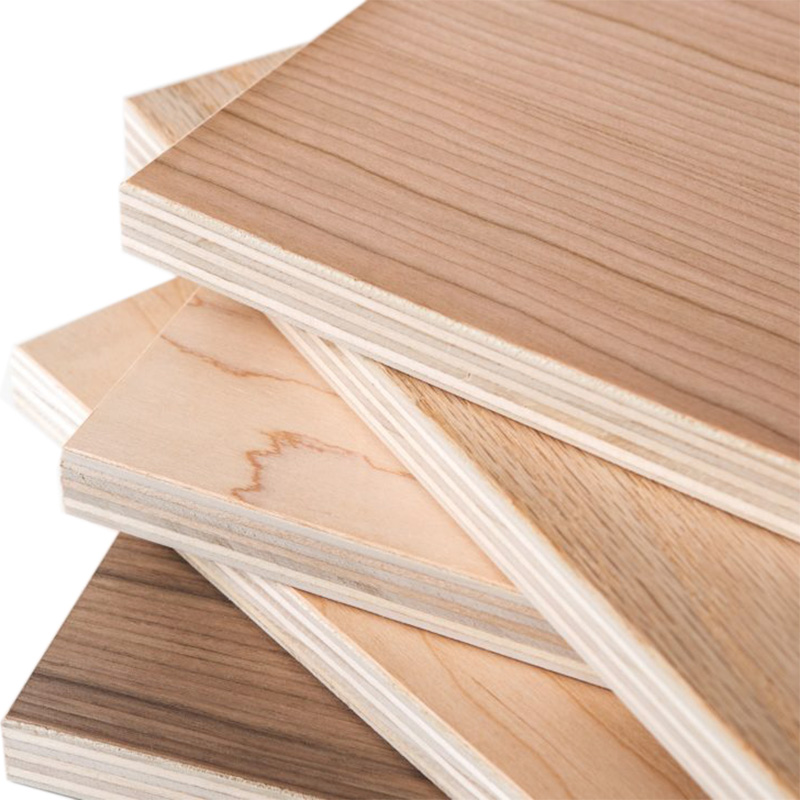
Eco-Board (Melamine-Faced Board): The Ready-to-Use Solution
Eco-board features a core of blockboard or plywood pre-laminated with a melamine-impregnated decorative paper, eliminating the need for post-assembly painting.
Core Advantages: This board is prized for its environmental credentials, as the core uses less glue and the melamine surface emits no formaldehyde, often easily achieving E0 standards. It saves significant time and labour as it's ready to use immediately after installation. The surface is easy to clean, resistant to wear, and comes in a vast array of colours and patterns.
Key Disadvantages: The cut edges are critical weak points; they must be professionally sealed to prevent moisture ingress and chipping. Its load-bearing capacity is generally lower than multi-layer solid wood boards, making it unsuitable for heavy-duty applications. The surface, while耐磨, can be permanently scratched by sharp objects.
Ideal Use Cases: Perfect for wardrobes, shoe cabinets, desks, and children's room furniture—ideal for families prioritizing quick installation and eco-friendliness.
Oriented Strand Board (OSB): The Strong and Durable Workhorse
OSB is engineered from large, oriented strands of wood (typically in three layers) bonded under heat and pressure. The strands are arranged in specific directions to maximise strength.
Core Advantages: OSB boasts exceptional strength and load-bearing capacity, outperforming particleboard and plywood in structural applications, thanks to its oriented structure. It also has excellent environmental properties, often reaching E0/ENF levels due to high wood content and low resin use. It offers superior moisture resistance and remarkable stability, even with unsealed edges for short periods.
Key Disadvantages: The main drawback is its rough, textured surface, which requires veneering or painting for aesthetic use. It is also approximately 30-50% more expensive than particleboard and is notably heavy, which can complicate handling and installation.
Ideal Use Cases: OSB is best for structural frameworks, sub-flooring, roof decking, and industrial packaging. It is also suitable for furniture requiring high load-bearing capacity.
Medium-Density Fibreboard (MDF): The Smooth Canvas for Design
MDF is made from broken-down wood fibres combined with resin and pressed into dense, smooth sheets. It is available in low, medium, and high densities.
Core Advantages: MDF's primary benefit is its perfectly smooth, homogeneous surface, free of grain, which makes it ideal for painting, veneering, and intricate machining like carving and routing. It can be shaped into complex profiles (e.g., raised panel doors) and offers a cost-effective way to achieve a high-end, painted finish.
Key Disadvantages: It has very poor moisture resistance, prone to swelling and deformation in humid environments, ruling it out for kitchens or bathrooms. The large surface area of fibres requires a lot of adhesive, posing a formaldehyde risk if low-quality glue is used. It also has poor screw-holding strength, making it unsuitable for structural frames.
Ideal Use Cases: MDF is the go-to material for painted or laminated cabinet doors, decorative mouldings, speaker boxes, and craft projects where a flawless surface is paramount.
Making the Final Choice
The optimal board depends on a careful evaluation of project requirements. Key considerations include:
Budget: Is cost the main constraint, or is there room for premium materials?
Environmental Requirements: Are low VOC and E0/ENF certifications mandatory?
Processing Needs: How important is ease of cutting, shaping, or post-finishing?
Environmental Conditions: Will the board be used in a humid area like a bathroom or a dry living room?
Aesthetics and Style: Is a perfect painted finish, a natural wood look, or a decorative pattern desired?
Fire Safety: Are there specific fire-retardancy requirements, especially in commercial or public spaces?
Load-Bearing and Durability: Does the application require high strength and long-term resilience?
By systematically weighing these factors against the properties of Plywood, Eco-Board, OSB, and MDF, the path to the right material for any project becomes clear.