

Right Heat Zones Beat Max Heat
Many plywood-mill owners still believe a veneer drying machine should simply run as hot as possible. In reality, “how hot should it be inside” is the wrong question. The right question is: what temperature should each zone be, for this species, this thickness, and this target moisture? A wood veneer dryer is not a furnace. It is a controlled heat-and-moisture system, and temperature without zoning is just wasted fuel and cracked edges.
For most plywood-core veneers, the journey starts at the infeed. Wet veneer coming off the lathe often carries 60%–100% moisture, sometimes more during the rainy season. If that sheet hits 150°C–180°C immediately, the surface fibers snap dry while the inside is still soaked. The edges—exposed on two sides—dry fastest, shrink first, and split. That is why every well-designed Shine line uses a preheat or conditioning zone at 80°C–100°C. The goal here is not to remove bound water aggressively, but to wake up the moisture gradient: let surface water move outward, let the sheet relax, and prepare it for the main drying zone.
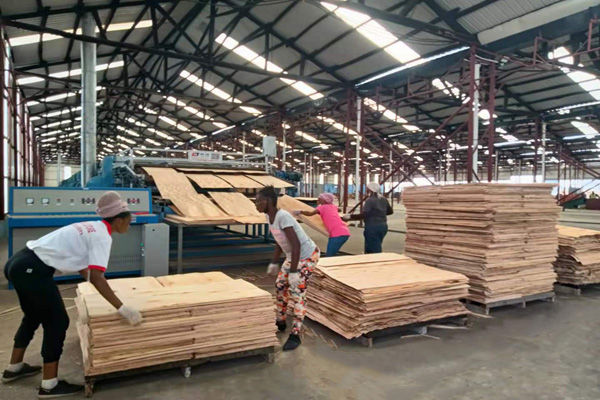
The main drying zone is where most free and bound water leaves the sheet. For medium hardwoods such as poplar, rubberwood, Falcata, and Lauan, the practical main-zone band is 120°C–155°C. Rubber wood, which contains more gum and starch, is comfortable around 140°C–155°C but suffers if pushed much higher for too long. Pine and other resinous softwoods prefer a gentler path: preheat near 80°C–90°C, main zone 120°C–130°C, because aggressive heat forces resin to the surface and fouls rollers and belts. Hard hardwoods like birch, beech, and oak migrate moisture slowly and need longer residence time rather than higher peak temperature; their main zone is often 130°C–150°C, with line speed reduced instead of heat maximized.
Thin decorative veneers are a completely different story. A 0.3 mm–1.5 mm face sheet or engineered dyed veneer cannot take roller-dryer brutality. In a mesh belt veneer drying machine, the inlet may sit at 70°C–90°C and the main zone at 90°C–130°C. Go hotter and the dye shifts, the grain closes, the sheet cups, or micro-checks appear that only show up after gluing. High-end face stock is dried, not cooked. That is why Shine mesh belt lines emphasize low inlet temperature, dual-side airflow, and a separate cooling section rather than a single “blast it dry” setting.
Then comes the part many factories ignore: the exit and cooling zone. A sheet leaving the last heat zone can still be 80°C–120°C. If it is stacked immediately, trapped vapor builds steam pressure between sheets, edges open up an hour later in the yard, and pine can even self-ignite. A proper wood veneer dryer therefore does not end at “hot.” It ends with a cooling zone—natural or forced-air—that brings sheet temperature below 40°C before stacking. In temperature terms, the final zone is deliberately dropped to 90°C–110°C or lower, then cooling takes over. Drying ends gently; it should never end with a hot bundle wrapped in plastic.
Roller dryers and mesh belt dryers also speak different temperature languages. Shine roller core-veneer dryers are often rated for chamber air around 140°C–200°C, because thick core and back veneers can absorb that energy and because mechanical roller contact helps keep the sheet flat. But “140°C–200°C adjustable” does not mean “run at 200°C all day.” It means the machine is built to survive that range; the operator should still use a curve: low inlet, strong middle, softer finish. Mesh belt face-veneer dryers, by contrast, live in the 80°C–140°C world. Put a 0.5 mm walnut face into a 180°C roller dryer, and you will get a curly, discolored reject. Put a 3 mm rubber-wood core into a 90°C mesh belt dryer, and you will get a wet, slow, unprofitable line.
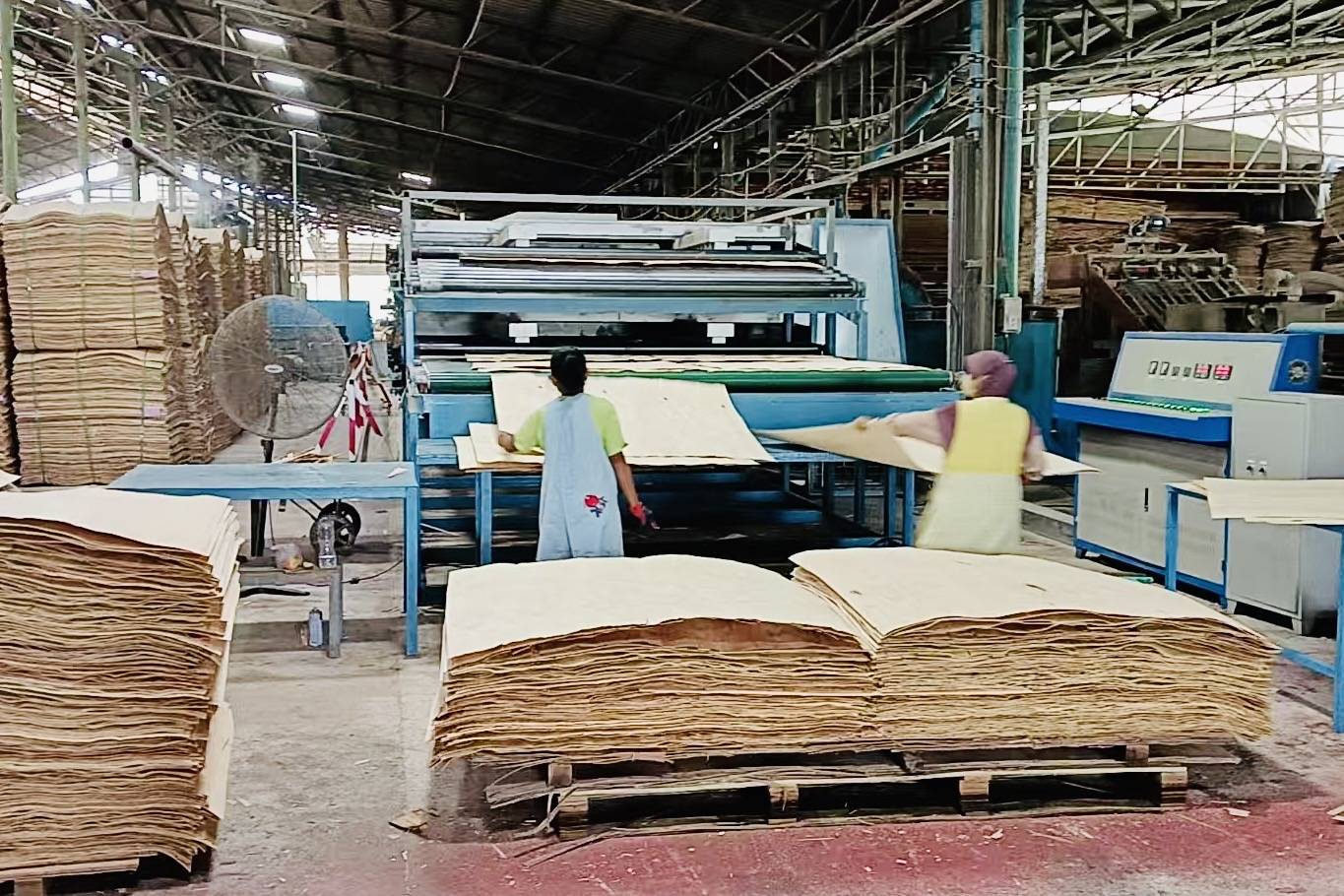
Species-specific recipes matter more than the nameplate. Falcata and Lauan: inlet 80°C–90°C, main 125°C–135°C, cool below 40°C. Poplar: inlet 80°C–90°C, main 120°C–130°C, protect from fast heat to avoid warping. Rubber wood: inlet 90°C–100°C, main 140°C–155°C, cool well to avoid mold. Pine: inlet 80°C–90°C, main 120°C–130°C, slower speed, strong exhaust. Birch/beech: inlet 90°C–100°C, main 130°C–145°C, longer time. Engineered veneer: inlet 70°C–80°C, main 90°C–110°C, dedicated cooling. These are not “Chinese settings” or “European settings”—they are wood-physics settings.
The commercial reason is simple. Target final moisture for plywood veneer is usually 8%–12% for face and back, sometimes 10%–14% for core depending on the glue line and climate. If the dryer runs too hot, the sheet hits 5% in the middle and 14% at the edges—same board, two moisture worlds. The hot press then turns that sheet into blisters, starved glue lines, or delamination. If the dryer is zoned correctly, the same sheet leaves at 8%–12% across the whole width, glues cleanly, and upgrades from BB/CC to AB or AA. On a 60 m³/day line, moving two or three percent of output from core grade to face grade pays for the temperature-control system many times over.
Shine veneer drying machines are built around this logic. Each heating section has its own heat exchanger and circulating fan, so hot air is not just “blown through” but distributed, recirculated, and balanced. The 5.5 kW axial fans move large air volumes at low resistance, the exhaust fans remove moisture-laden air without throwing away all the heat, and the optional heat-recovery unit preheats incoming air with outgoing exhaust—typically cutting energy use by double digits. Temperature control accuracy on Shine roller lines is around ±5°C, and the PLC can store recipes: one button for poplar core, one for rubber-wood back, one for birch face, one for engineered veneer. The machine does not guess; the operator selects the wood, and the curve follows.
A good rule for any buyer: do not ask “what is the maximum temperature?” Ask “what is the zone profile for my wood?” If a supplier answers “200 degrees, very strong,” walk away. If they answer “inlet 80–100, main zone by species, exit cooling below 40, final MC 8–12,” they understand veneer. A veneer drying machine is an asset only when temperature is a tool, not a threat.
In the end, the inside of a wood veneer dryer should look less like a pizza oven and more like a climate chart. Low at the door, firm in the middle, gentle at the exit, cold at the stack. Get those zones right, and you save fuel, cut edge cracks, stabilize moisture, and turn more sheets into sellable face veneer. Get them wrong and you simply burn money at both ends—too much heat going in, too many rejects coming out.
Shine Machinery’s message to every plywood and veneer mill is straightforward: stop drying with maximum temperature, start drying with the right zone profile. Preheat kindly, dry firmly, finish softly, cool completely. That is how a veneer drying machine earns its place on the floor—and how a wood veneer dryer turns wet peeled sheets into flat, uniform, glue-ready veneer, shift after shift, season after season.