

Auto-Feed Veneer Dryer Wins
When plywood and veneer mill owners talk about upgrading a wood veneer dryer, they usually start with heat source, deck count, fuel cost, and final moisture content. Those points matter. But one detail quietly decides whether the expensive dryer behind the wall actually runs at its designed capacity: the infeed.
A manual loader can place sheets all day, but humans get tired, take breaks, change shifts, and feed at uneven speed. The dryer keeps burning fuel whether veneer is entering or not. That gap is where money leaks out. Adding a fully automatic infeed system to a veneer drying machine is not a luxury accessory. It is the front gate of the whole drying line. Get the front gate right, and the roller dryer, mesh belt dryer, or multi-deck dryer behind it finally performs the way the quotation promised.
Manual feeding looks cheap, but hides real cost
In a conventional plywood veneer drying line, workers lift green veneer from the stack, separate stuck sheets, align them by eye, and push them onto the conveyor. At low volume, this looks fine.
At 20-hour shifts, rainy-season moisture, and urgent export orders, the cracks appear:
Sheet overlap blocks hot-air penetration.
Skewed sheets hit side guides and jam the line.
Gaps at the infeed force the dryer to heat empty air.
Wet veneer waits on the floor and reabsorbs moisture.
Fatigue causes wider spacing, lower fill rate, and unstable output.
Skilled feeders quit, new workers misalign sheets, and quality drifts.
None of these problems show up as a line item on the dryer invoice. They show up later as higher fuel use, lower Grade-A yield, more rejects before gluing, and overtime paid to keep the peeling line from backing up.
An automatic veneer loader fixes the cause, not the symptom.
What the automatic infeed system actually does
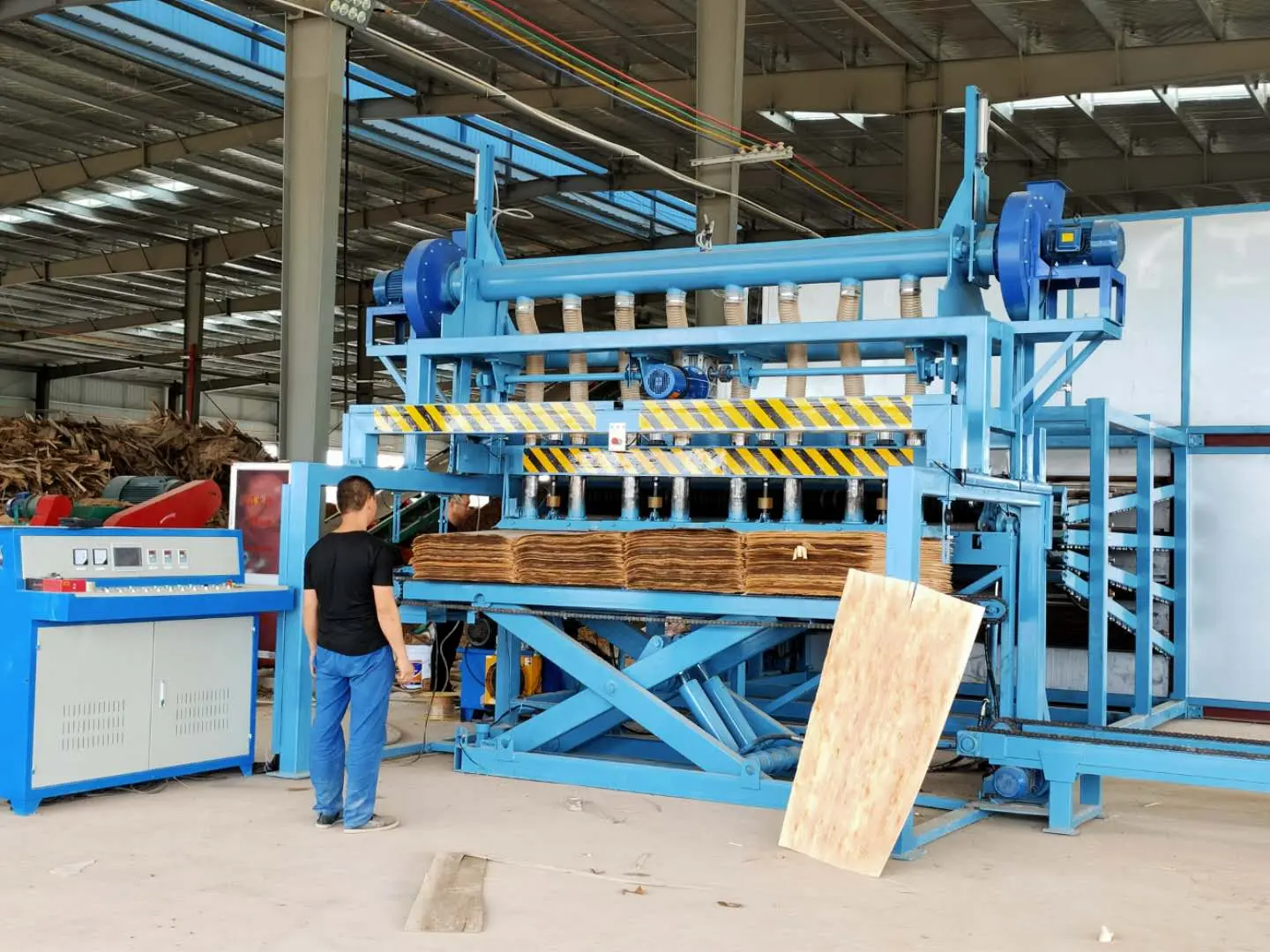
A modern automatic loading system receives peeled green veneer from a presentation table or conveyor, separates single sheets, squares them, sets the correct gap, and feeds them into the dryer at a pace synchronized with the belt or roller speed.
On Shine dryers, the loader communicates with the dryer PLC and VFD. If the line runs at 5 m/min or 22 m/min, the infeed cycle adapts. The chamber stays consistently filled. The burner does not swing between “too full” and “almost empty.”That single change improves five things at once: labor, throughput, quality, safety, and energy efficiency.
Advantage 1: Labor drops from a team to a supervisor
Manual drying lines often need four to eight people per shift just for feeding and stacking. With an automatic infeed system, the loading end usually needs only one or two monitoring operators.
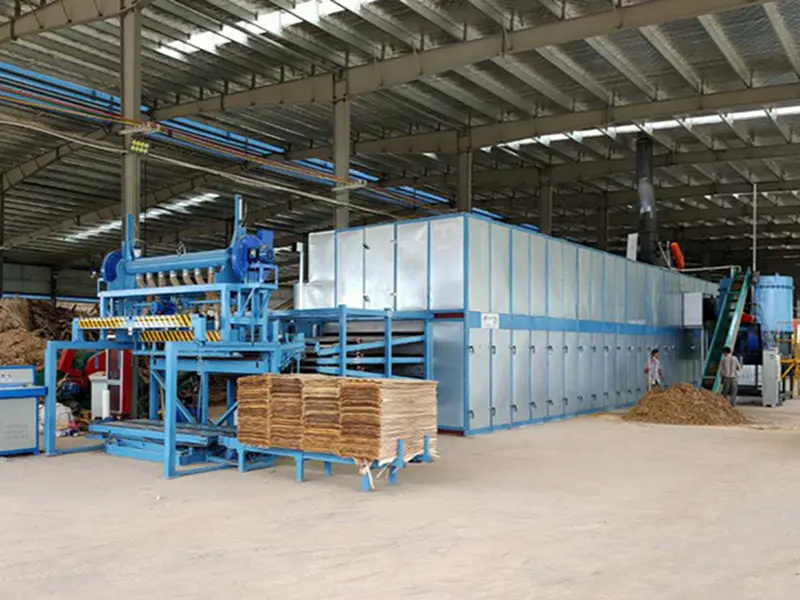
Shine’s automatic loader is compatible with 2-deck, 3-deck, 4-deck, and 6-deck roller veneer dryers. Documented system power is around 15.1 kW across lift servo, rubber-covered roller delivery, belt transport, lifting-table chain, hydraulic station, and traction motor.
The business impact is bigger than wage savings:
Fewer recruits to train.
Less dependence on experienced feeders.
No production collapse when the best worker resigns.
Day shift, night shift, and weekend shift run the same way.
For mills in regions with rising wages or migrant-labor shortages, this alone can justify the upgrade.
Advantage 2: Dryer utilization goes up, fuel per cubic meter goes down
A veneer dryer reaches peak thermal efficiency when material flow is steady and the decks stay filled. Manual feeding creates micro-gaps every few minutes. Those gaps look small, but across a 20-hour day they add up to a dryer heating air instead of wood.
Automatic infeed keeps the chamber loaded close to design density. Better fill rate means:
More cubic meters dried per shift.
Fewer start-stop disturbances in temperature zones.
Steadier exhaust humidity signal.
Less fuel burned to re-stabilize chamber conditions.
Shine has documented cases where automated feeding and collection raise effective throughput by double digits, with some configurations approaching 30% improvement versus unstable manual lines. The exact number depends on veneer thickness, species, incoming moisture, deck count, and how bad the manual baseline was.
The point is simple: a cheaper dryer with bad feeding can cost more per cubic meter than a better dryer with automatic infeed.
Advantage 3: Moisture uniformity improves because sheets enter correctly
Veneer drying defects rarely start in the middle of the chamber. They start at the entrance.
If two sheets overlap, hot air cannot reach the trapped layer. One sheet comes out at 16% moisture, the other at 7%. Warp, crack, mold risk, glue failure, and press delamination follow downstream.
Automatic loading reduces placement deviation. Sheets are singulated, centered, and spaced consistently. Convective heat reaches the full sheet width. The dryer’s own zone control then works the way engineers designed it. For face veneer, back veneer, decorative species, eucalyptus, rubberwood, pine, spruce, hemlock, Douglas fir, or larch, consistent infeed is the first step to consistent final moisture.
Buyers often ask for 8%–12% final moisture. You do not get there only by raising temperature. You get there by controlling how the sheet enters, how fast it moves, and how evenly air touches the surface.
Advantage 4: Delicate green veneer gets handled gently
Freshly peeled veneer is weak. Thin decorative sheets curl. Plantation eucalyptus and rubberwood smear under rough handling. Pine and larch resins make sheets stick together. Manual crews wearing gloves still drop sheets, drag them across metal, and crush edges. Those marks may not matter for core stock, but they destroy the value of A-grade face veneer.
Automatic systems use controlled separation, soft conveyance, guided alignment, and sometimes vacuum or air-assisted pickup. The sheet is moved, not wrestled.
Result:
Fewer edge tears.
Fewer pressure marks.
Less scuffing on decorative surfaces.
Higher share of sellable top-grade veneer.
When the customer is a furniture panel maker or architectural veneer buyer, that upgrade pays for itself in grade mix, not just labor hours.
Advantage 5: Safer plant, better workforce deployment
Feeding sheets into roller nip points is dangerous. Wet veneer is heavy, slippery, and unforgiving. Repetitive lifting causes back injuries, hand crushes, and high turnover.
Automating the infeed removes people from the highest-risk repetition zone. Remaining staff move to higher-value roles:
Quality spotting.
Moisture checking.
Stacking supervision.
Maintenance rounds.
Data logging and shift reporting.
The machine does the bending. The human does the judging. That is the right division of labor in a modern mill.
Advantage 6: Humid climates stop stealing your drying budget
In Southeast Asia, South America, and coastal China, peeled veneer starts regaining moisture almost immediately. During rainy season, sheets sitting in carts can climb 2%–3% in moisture before they ever enter the dryer.
Manual lines make this worse because stacking, cart moving, and queueing take time. Automatic infeed supports direct flow from lathe to dryer. Conveyor networks move sheets from the peeler to the infeed table with minimal floor time. The wood enters the chamber closer to its true peeled moisture.
That means:
Less total water to evaporate.
Shorter residence time.
Lower fuel per cubic meter.
Lower fungus-stain risk in humid weather.
For tropical mills, this is not a convenience. It is a quality-protection system.
Advantage 7: It prepares the line for real digital control
Manual feeding is variable by nature. Sensors can measure the chamber, but if the entrance keeps changing, the controller is always chasing a moving target.
Automatic infeed creates a stable, repeatable front end. On top of that, mills can add:
Sheet counting sensors.
Inline thickness detection.
Near-infrared moisture scanning.
Species-based recipes.
PLC logging for OEE and traceability.
Remote alarms for misfeed, overlap, or conveyor fault.
Once infeed is stable, the dryer becomes part of a connected line instead of a standalone box with a burner.
Shine dryers already use PLC, VFD, zonal temperature control, and recipe-based operation. Automatic loading is the mechanical foundation that makes those controls meaningful.
But be honest about the trade-offs
Automatic infeed is not magic. Buyers should ask the right questions:
Is my veneer thickness range suitable for mechanical separation?
Do I need vacuum, fork, air-blow, or belt-type feeding?
Will the loader handle curled, stuck, or resinous sheets?
How much extra power does the loading system add?
Can the system retrofit my existing 2-deck or 3-deck dryer?
Does the supplier provide commissioning, spare parts, and local service?
Is the saving in labor, yield, fuel, or all three?
On Shine systems, the loader itself adds around 15.1 kW. That sounds like more electricity, but if it raises effective output, cuts rejects, and keeps the dryer from heating empty space, the cost per cubic meter usually falls.
Do not compare “manual = free” with “auto = extra motor.” Compare total cost per dried cubic meter.
Who should buy it first
Automatic infeed pays back fastest for:
Mills running two or three shifts.
Mills drying thin or decorative veneer.
Mills in high-wage or labor-scarce regions.
Mills with peeling capacity bigger than dryer capacity.
Mills exporting panels with strict moisture and appearance specs.
Mills where manual feeding already causes jams, overlaps, and grade loss.
If you run one shift, low volume, and core-only plywood, a semi-automatic system may be enough. But if the dryer is the bottleneck between peeling and pressing, full automatic infeed is usually the cheapest capacity you can buy.
A simple way to justify the upgrade
Run a one-week baseline before buying:
Sheets per minute into the dryer.
Deck fill rate, percent of usable length occupied.
Misfeeds and jams per shift.
Labor hours at infeed and outfeed.
Final moisture spread across the sheet.
Fuel or kWh per cubic meter dried.
Grade-A versus reject rate after drying.
Then install the automatic loader and measure the same numbers for one week.
Most mills do not need a sales pitch after that. The data shows the gap, the jam rate, the labor count, and the moisture spread all moving the right direction.
Bottom line
A veneer dryer is only as good as the sheet entering it.
Automatic infeed turns a chaotic, labor-dependent entrance into a precise, synchronized gateway. It cuts headcount, improves moisture uniformity, protects delicate veneer, reduces humid-climate moisture regain, lowers fuel wasted on empty chamber time, and sets the line up for Industry 4.0 control.
For a modern plywood or veneer mill, the question is no longer “Should we automate the infeed?” The better question is “How much money are we losing at the front of the dryer every shift we wait?” Shine Machinery builds automatic loading systems for 2-deck, 3-deck, 4-deck, and 6-deck roller veneer dryers, with PLC synchronization, adjustable feeding rhythm, and retrofitting options for existing lines. If your peeler can feed more than your dryer can accept, the infeed system—not a bigger burner—is probably the first upgrade to spec.
Talk to us about your veneer size, species, incoming moisture, target moisture, and daily cubic-meter goal. We will size the dryer and the loader together, because in real production they are one machine split into two boxes.