

7 Checks Before Buying Veneer Dryer
Purchasing a veneer drying machine is one of the most consequential capital decisions in any plywood or veneer mill. The wrong choice does not just cost money upfront—it locks the factory into years of high fuel bills, excessive labor, grade rejections, and maintenance headaches. Yet many buyers still lead the conversation with a single question: "How much is it?" Price matters, but only after the technical foundation is solid. Before issuing a single inquiry, every mill owner should work through seven categories of information. Get these right and the drying line becomes a profit center. Skip them and the machine becomes an expensive lesson.
1. Know your raw material and output targets
No two wood species dry the same way. Pine, Douglas Fir, Larch, Spruce, Hemlock, Poplar, Rubber Wood, Falcata, and Lauan each carry different density, resin content, and fiber structure. A wood veneer dryer tuned for poplar will not automatically deliver good results on pine or larch. Resin-rich species demand lower peak temperatures and more aggressive cleaning cycles. Light, low-density species need gentler airflow to avoid curl and wrinkle. Before contacting any supplier, confirm the exact species mix, veneer dimensions, and daily volume in cubic meters—not just "pieces per day."
For example, a common specification in Southeast Asia is plywood veneer at 2550 mm × 1350 mm × 2.5–4.5 mm, with a target capacity of 20,000 square feet per hour. Converted, that equals roughly 8 cubic meters per hour. This kind of conversion is essential because equipment is engineered around volume throughput, not sheet count. Also define the initial moisture content coming off the lathe—often 60%–100% during rainy season—and the target final moisture, typically 8%–12% for face and back veneers, or 10%–14% for core. Without these numbers, no supplier can size the heating load correctly.

2. Choose the right machine type
3. Confirm heat source and site conditions
Heat source dictates machine configuration. Biomass, steam, natural gas, thermal oil, and electric each require different ducting, burners, and safety systems. A mill with an existing steam boiler should prioritize a steam-heated dryer. Where wood waste or biomass pellets are abundant, biomass firing typically offers the lowest operating cost. Natural gas is cleaner but more expensive. Electric heating is usually the most costly per cubic meter dried.
4. Demand hard technical parameters in writing
A credible quotation should list effective drying width, number of sections, number of decks, temperature range per zone, and control accuracy—quality machines hold ±1–2°C. Line speed range, fan count, motor power, and airflow volume must be specified. Clarify air circulation mode: single-side or dual-side, and recirculation ratio. Top-tier dryers recirculate 80%–90% of zone air, exhausting only moisture-laden fractions. Heat exchanger material and anti-resin coating are critical for pine and larch. Moisture uniformity tolerance should be stated—leading machines hold within ±1.5% across the full sheet width.
5. Calculate total cost of ownership
6. Vet the manufacturer thoroughly
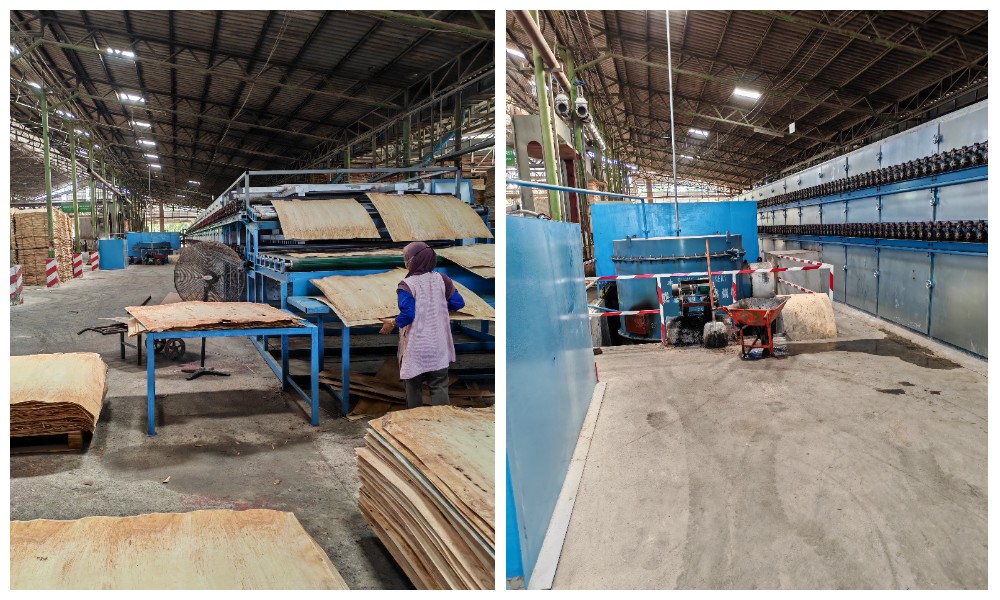
Distinguish between genuine manufacturers with their own workshops and trading intermediaries. Request real reference cases for the same species, thickness, and throughput—not just photos, but recent operational reports showing moisture uniformity and fuel consumption. Ask whether the supplier conducts multi-point temperature field tests and 24-hour continuous run trials. Confirm the control system is proprietary PLC programming, not a cobbled-together generic panel. For export, verify CE compliance, voltage adaptation, fumigation-certified export packaging, and customs documentation capability. After-sales response time, local service presence, spare parts inventory, and whether commissioning and training are included in the contract—all of these separate professional suppliers from risky ones.
7. Lock everything in the contract
A simple pre-inquiry checklist
Species list: ________________
Veneer size: ________________ Thickness range: ________________
Initial MC → Target MC: ____% → ____%
Hourly / daily output: ____ m³/h, ____ m³/day, ____ shifts
Available heat source: steam / biomass / gas / thermal oil / electric
Site dimensions L×W×H: ________________ Clear height: ____
Local fuel cost: biomass __ gas __ electricity __
Environmental rules: dust removal □ VOC control □ emission permit □
Automation level: manual □ semi-auto □ fully auto □
Budget range & destination port (export) / installation address (domestic) ____________
Send this completed form to a supplier and the returned proposal will actually be comparable to others. Without it, three quotes will describe three different machines at three different capability levels.
A veneer drying machine is not a commodity. It is a precision thermal system engineered around a specific wood, a specific thickness, and a specific production target. The mills that prosper are the ones that treat procurement as a technical process, not a price auction. Define the wood, define the output, verify the parameters, calculate the real cost, check the references, and write the standards into the contract. Do this and the dryer will pay back many times over. Skip a step and the line will remind you every shift, every fuel bill, and every rejected bundle.