

Why Dry Rubber Veneer Immediately?
Rubberwood is one of the most widely used species in plywood manufacturing today. It grows fast, machines well, and offers a consistent light color that takes laminate and paint beautifully. But rubberwood has a hidden weakness that can destroy an entire batch of veneer within a single day: it rots, sours, and discolors faster than almost any other commercial hardwood.
If you run a plywood mill, a veneer trading business, or you are specifying equipment for a new rubberwood processing line, this article will explain exactly why freshly peeled rubber veneer must enter a dryer within hours—not days, not even half a day. We will break down the biochemistry, the timeline of deterioration, the drying parameters that actually work, and the equipment choices that separate profitable mills from those drowning in rejected core stock.
1. The biochemistry problem: rubberwood is a microbe buffet
Freshly peeled rubberwood veneer typically exits the lathe at 60% to 80% moisture content. That water is not the only problem. Rubberwood contains three compounds that make it uniquely vulnerable to rapid degradation:
High starch and sugar content. These carbohydrates are exactly what mold fungi feed on. Black mold (Aspergillus niger) and green mold (Penicillium) can germinate on rubber veneer within hours of peeling.
Residual rubber proteins. These proteins continue to break down after the tree is felled. In a warm, wet environment, they ferment and produce organic acids. The veneer becomes sticky, sour-smelling, and chemically altered.
Wide, open vessels. Rubberwood has coarse grain and large vessels. Once stain fungi take hold on the surface, they travel deep into the wood through these vessels. Discoloration is not just skin-deep—it penetrates the fiber layer.
Compare this to other species. Poplar molds slowly, usually taking 8 to 12 hours before visible spots appear. Pine has natural resins that inhibit bacterial growth. But rubberwood? It is among the fastest-spoiling hardwoods in commercial veneer production. There is no close second.
2. The deterioration timeline: from fresh peel to worthless
Understanding the clock you are racing against is critical. Here is what happens to a stack of rubber veneer left at ambient temperature after peeling:
Stage 1: 2 to 6 hours after peeling
Tiny black or green mold spots appear on the surface, usually starting at cut edges and knot areas.
The sheet still feels normal, but microscopic fungal colonies are already established.
If veneer enters a dryer at this stage, the high heat (120°C / 248°F and above) kills surface mold within minutes. The sheet can still be saved and graded as usable.
Stage 2: 6 to 24 hours after peeling
Mold patches merge into larger colonies. Surface blue stain (sapstain fungi) begins penetrating the vessels.
The veneer develops a sour, fermented odor. Surface tackiness appears from protein breakdown.
Glue bond strength starts to decline because acidic metabolites interfere with adhesive curing.
After drying at this stage, moisture content drops normally, but the color shift is permanent. The sheet is downgraded.
Stage 3: 24 to 48 hours after peeling
Discoloration reaches deep into the fiber layer. The entire sheet turns gray-green or blue-gray.
Organic acids from fermentation begin attacking the fiber structure itself.
Risk of delamination during hot pressing rises sharply.
At this point, the veneer is effectively scrap. It may serve as the lowest-grade core material at best, but most mills reject it entirely.
This timeline is not theoretical. Walk into any mill in Thailand, Vietnam, India, or China that processes rubber wood, and you will hear the same rule repeated by veteran floor supervisors: "Two hours. If it is not in the dryer within two hours, you are gambling."
In hot, humid summer conditions, that window shrinks to one hour or less.
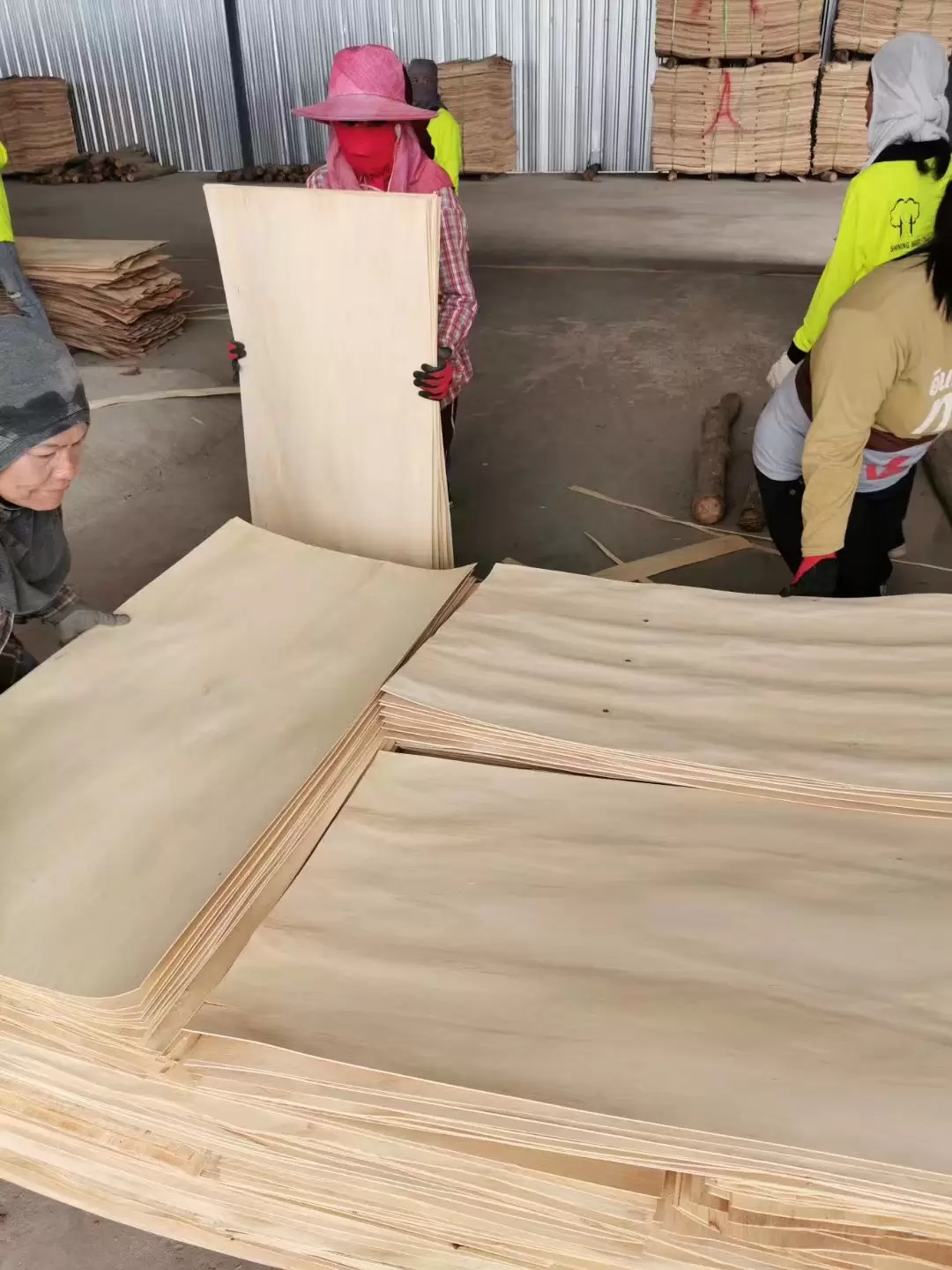
3. What immediate drying actually fixes
A properly configured veneer dryer does more than remove water. For rubberwood specifically, rapid drying solves five interconnected problems at once:
Kills surface mold and bacteria. The main drying zone at 120–160°C (248–320°F) destroys over 99% of microbial activity within 3 to 5 minutes of exposure. This is not a sanitizing step—it is simply the thermal reality of forced hot-air drying.
Cuts off the moisture supply. Dropping moisture content from 70% to below 12% removes the environment that fungi need to survive. Below 20% MC, most mold species stop growing. Below 12%, they are dormant.
Locks in the wood color. High heat causes tannins and natural pigments in rubberwood to "set," preventing oxidative browning during storage. Properly dried rubber veneer retains its clean, pale appearance for months.
Reduces internal stress and warp. Drying while the veneer is still warm and pliable from the lathe produces more even moisture evaporation. Less internal stress means flatter sheets and fewer rejects at the clipper or jointer.
Protects glue bond strength. Veneer dried promptly has no acidic surface metabolites. Adhesives penetrate normally and cure at full strength. This directly affects the plywood lay-up yield and long-term panel durability.
4. Drying parameters that work for rubberwood
Rubberwood behaves differently from pine and differently from poplar. Here is what field data and equipment manufacturers recommend:
Parameter | Recommended Range | Notes |
|---|---|---|
Preheating zone | 80–100°C (176–212°F) | Gradual surface warming prevents surface case-hardening |
Main drying zone | 130–155°C (266–311°F) | Rubberwood tolerates higher heat than pine; no need for low-temp slow drying |
Cooling zone | Below 40°C (104°F) at exit | Prevents heat damage to stacked sheets and reduces condensation in storage |
Thickness adaptation | 1.7–2.5 mm: 110–130°C; 2.5–3.0 mm: 140–155°C | Thinner sheets need lower temperatures to avoid over-drying and edge burn |
Target final MC | 8%–12% for face/back; 10%–14% for core | Consistent MC across the sheet is more important than the exact number |
These ranges assume a continuous roller veneer dryer with zoned temperature control and VFD speed adjustment. Batch-type press dryers can also work if the cycle time is tuned for rubberwood's fast-drying characteristics.
5. Equipment choice: why continuous dryers win for rubberwood
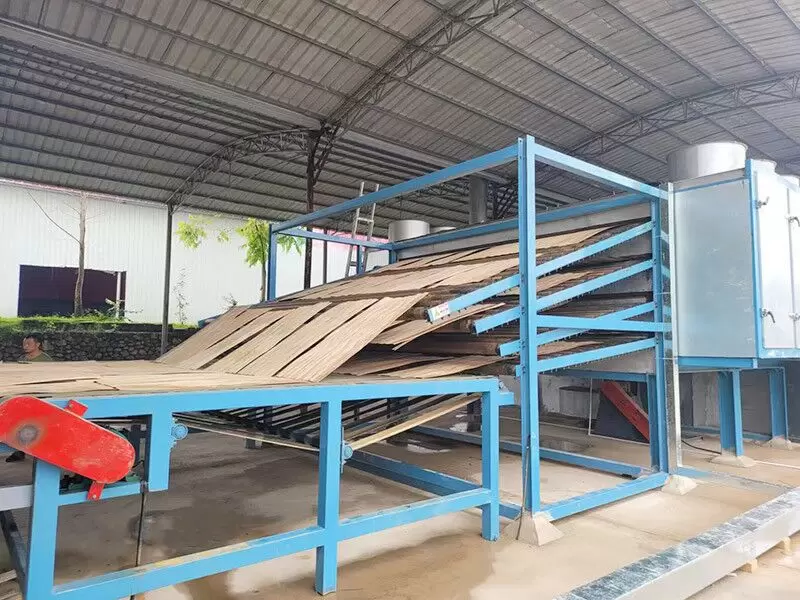
The single biggest advantage of a roller veneer dryer for rubberwood is that it eliminates the pile-up problem entirely. Veneer comes off the lathe or clipper and goes straight onto the infeed conveyor. It never sits in a stack on the floor. The clock starts at peeling, but the dryer is already waiting.
With a multi-layer press dryer (batch type), you must load each deck by hand or with a semi-automatic loader. Even with two operators, there is a natural bottleneck: while one batch is drying (30–60 minutes), freshly peeled veneer is accumulating. Unless you have multiple press units running in rotation, veneer will sit—and the 2-hour clock keeps ticking.
This is why high-volume rubberwood mills almost universally choose continuous roller dryers, often with 3 or 4 decks to save floor length. A single 3-deck roller line processing 8–12 m³/h keeps pace with a high-output lathe and ensures no sheet waits more than minutes before entering the heat zone.
6. What to do when the dryer is full
No mill runs perfectly every day. What if your dryer is at capacity and fresh veneer keeps coming?
Never stack high. Maximum 10 to 15 sheets per layer, separated by wooden spacers for air circulation.
Keep stacks low and open. Do not wrap in plastic. Do not cover with tarps. Air must move through the pile.
Use forced ventilation. If available, point fans at the temporary stacks to keep air moving.
Prioritize by peel time. The oldest veneer goes into the dryer first, no exceptions.
Consider a holding conveyor. Some mills install a short belt conveyor loop that slowly moves veneer in a thin layer, buying 20–30 minutes of air exposure before the dryer has capacity.
These are damage-control measures, not solutions. The only real solution is dryer capacity matched to lathe output.
7. The cost of waiting
Let us put numbers on this. A typical rubberwood plywood mill processes 20–30 m³ of veneer per day. If just 20% of one day's output—say 5 m³—sits too long and develops mold or blue stain, that material drops from Grade A or B to Grade C or reject. The price difference between Grade A core stock and reject material can be USD 40 to 80 per cubic meter depending on the market.
Five cubic meters × USD 60 average loss = USD 300 per incident. If this happens twice a week, that is USD 2,400 per month in preventable losses—enough to pay for a significant portion of a dryer upgrade or an additional press unit.
And that calculation ignores the hidden costs: customer complaints, rework labor, glue waste on delaminating panels, and the opportunity cost of floor space filled with rejected stock.
8. Bottom line
Rubberwood veneer is not like other species. Its high starch, sugar, and protein content make it a perishable product from the moment the log is peeled. Two hours is the window. One hour in summer. Beyond that, you are not drying veneer—you are drying moldy, acidic, downgraded material that will never reach its full value.
The solution is straightforward: match your drying capacity to your peeling output, use continuous roller dryers when volume allows, and enforce a strict "peel-to-dry" time limit on the shop floor. No shortcuts. No "it will be fine overnight." It will not.
At Shine Machinery, we have helped rubberwood mills across Asia and Eastern Europe configure drying lines that keep pace with high-output lathes. From single-deck to four-deck roller dryers, from thermal oil heating to biomass combustion systems, we size every line around one non-negotiable principle: the veneer must never wait.
Send us your daily volume, veneer thickness range, available building dimensions, and fuel preference. We will design a drying system where every sheet of rubber veneer goes from lathe to dryer before the clock runs out—and every sheet comes out flat, pale, glue-ready, and profitable.