

Roller, Mesh, Flip Dryers Explained
Every plywood and veneer mill eventually faces the same question: “Which veneer dryer should I buy?” The answer is not “the biggest one” or “the cheapest one.” It starts with how the machine moves the veneer and how heat reaches the wood. In today’s market, the three mainstream structures are roller-type, mesh-belt, and flip-plate dryers. Each one exists for a reason, and each one fails badly if you put the wrong veneer through it.
A wood veneer dryer has one job: remove water from freshly peeled veneer and bring it to a glue-ready moisture level, usually 8%–12% for face and back veneers and 10%–14% for core stock. But “remove water” is not one problem. Thin decorative veneer curls. Thick core veneer warps if not restrained. Small or fragile sheets tear under pressure. That is why conveyor design—not just the heat source—decides whether your dryer makes money or makes rejects.
1. Roller-Type Veneer Dryer
The roller dryer moves veneer between upper and lower driven rollers. The rollers grip the sheet, pull it forward, and apply light mechanical pressure. Heat comes from two directions at once: hot air jets from above and below, plus conduction from the heated roller surface. This makes the roller dryer the workhorse for medium-to-thick veneers. In practice, roller dryers handle roughly 1.2 mm to 5.0 mm, with many mills running 2.2 mm and 2.4 mm core veneer on them every day.
Why buyers choose it:
Flatness: roller pressure suppresses curl, wave, and bow during dehydration.
Speed: combined convection + conduction dries thicker veneer faster than penetration-only airflow.
Throughput: ideal for continuous, high-volume plywood lines.
Moisture uniformity: thick sheets dry more evenly because heat enters from both the air and the roller surface.
The downside is also clear. Very thin veneer—say 0.3 mm to 0.8 mm—can wrinkle, mark, or tear between rollers. Roller dryers also have more bearings, more lubrication points, and more mechanical parts than a simple belt machine.
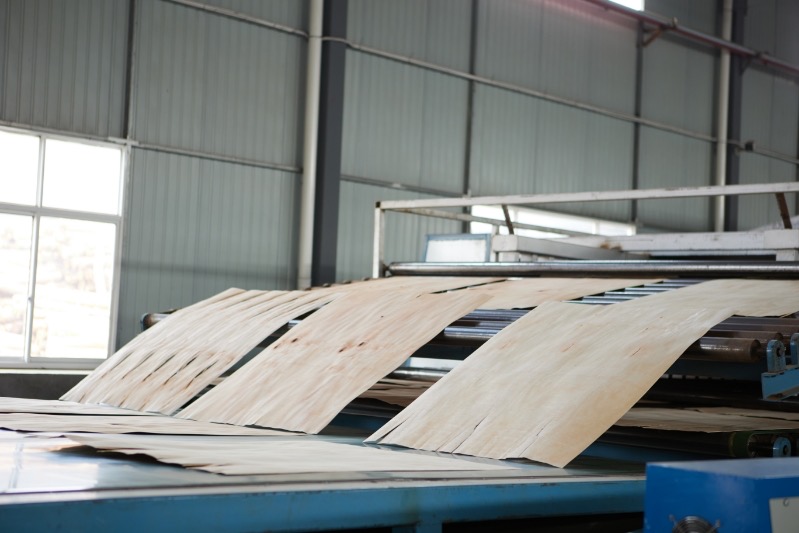
Choose a roller dryer if: you dry poplar, rubberwood, eucalyptus, Falcata, pine, or larch core/back veneer; your thickness is mostly above 1.2 mm; and your priority is tons-per-day, flat boards, and low moisture spread.
2. Mesh-Belt Veneer Dryer
The mesh-belt dryer lays the veneer flat on a continuous woven metal screen. There is no nip, no clamping, no roller pressure. Hot air is pushed vertically through the belt and through the sheet, so both faces dry at the same time.
Mesh belt dryers dominate the thin and fragile segment: roughly 0.3 mm to 1.5 mm, and sometimes up to 2.0 mm for stable species. They are the standard for face veneers, decorative slices, engineered veneer, reconstituted wood, and hotel-grade surface stock.
Advantages:
Gentle handling: no roller marks, no edge crush, no compression scars.
Penetration drying: vertical airflow treats top and bottom surfaces evenly.
Small pieces: broken or irregular veneer will not fall through a properly specified belt.
Automation-friendly: continuous infeed and outfeed integrate well with clipping and stacking lines.
Limitations:
Thick veneer dries poorly because airflow penetration resistance rises with thickness; the surface scorches before the core is dry.
Mesh belts are consumables. Dust, bark, and resin clog the openings; belts may need replacement every 1–3 years depending on species and maintenance.
Same capacity usually needs more floor length than a multi-deck roller machine.
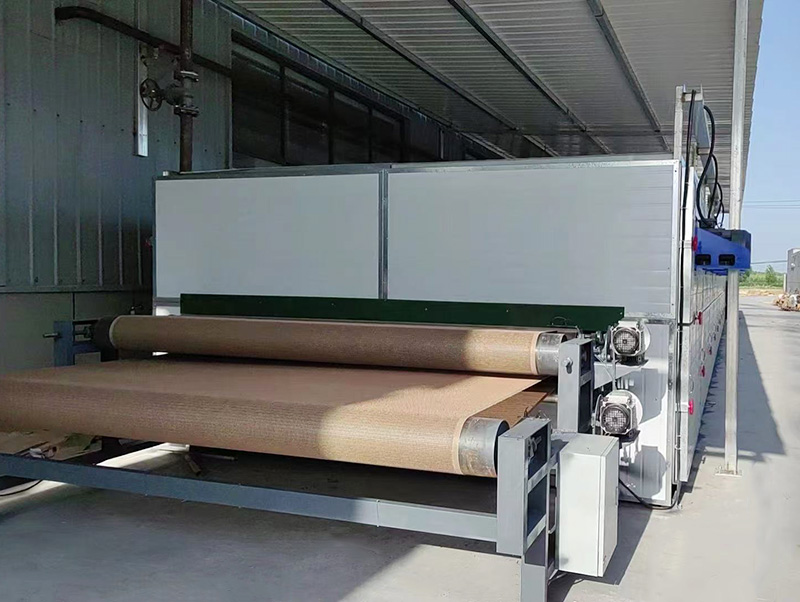
Choose a mesh-belt dryer if: you sell face veneer, decorative plywood, furniture surfacing, or engineered veneer; your thickness is mostly below 1.5 mm; and surface quality matters more than brute throughput.
3. Flip-Plate / Turnover Veneer Dryer
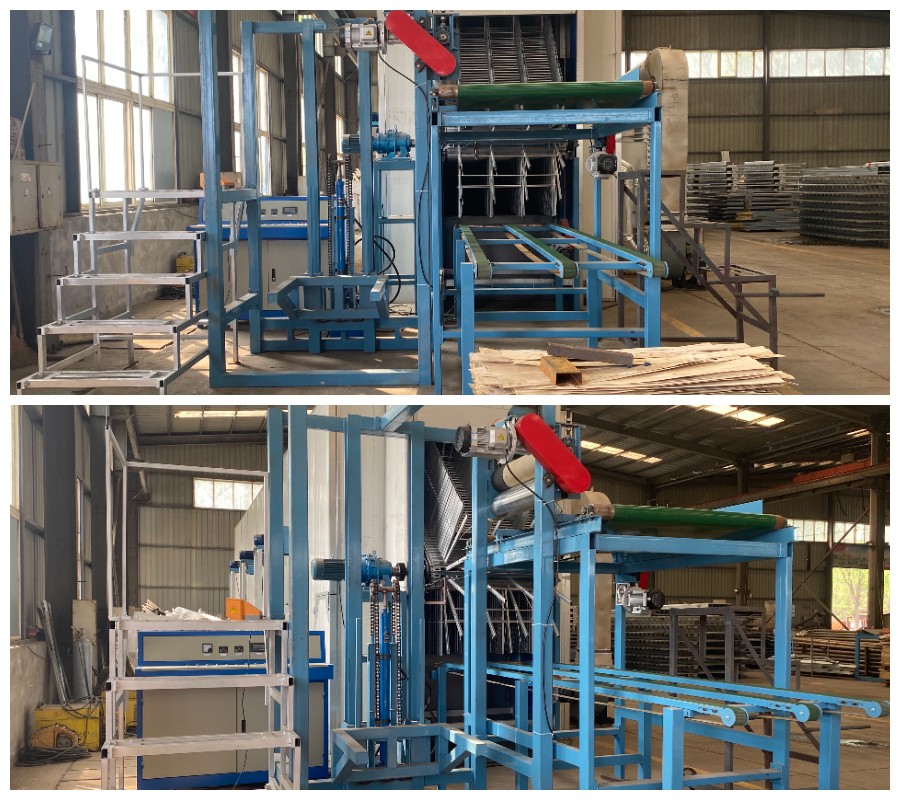
The flip-plate dryer is the quieter member of the family. Veneer sits on trays or plates, and the system moves the sheets through the chamber, often turning or reciprocating them so both sides see conditioned air. Some designs are vertical or semi-vertical, which saves floor space in older mills.
Flip-plate machines are not usually the highest-throughput option, but they are practical for:
Plants with limited building length.
Mixed small batches.
Fragile species that dislike roller pressure but still need support.
Operations where labor is limited and a compact automatic line makes sense.
The trade-off is capacity. A flip-plate line rarely competes with a 100 m³/day four-deck roller dryer. But for a mill doing 20–40 m³/day, retrofitting an old workshop, or drying specialty sheets, it can be the smartest layout decision.
Choose a flip-plate dryer if: your building is tight, your volume is moderate, and you want gentle handling without committing to a giant roller hall.
4. Another way to classify: heat transfer
Besides conveyor type, veneer dryers are also classified by how heat reaches the wood:
Convection dryers: hot air does the work. Most mesh-belt dryers belong here.
Contact dryers: heated plates or rollers touch the veneer. Hot-platen and roller dryers use conduction.
Radiation dryers: infrared or far-infrared heaters. Still niche; far-infrared resonates with water molecules but electricity cost is high.
Composite dryers: roller dryers are already convection + conduction. Some lines add infrared at the infeed or microwave at the outfeed to balance moisture. North American specialty plants use these hybrids, but they are not the everyday choice for commodity plywood.
For most buyers, the practical question is not “convection vs radiation.” It is: will my 0.5 mm face stock survive rollers, and will my 3.0 mm core stock stay flat on a mesh belt?
5. Heat source is separate from machine type
A common mistake is mixing up “dryer type” with “heat source.” Roller, mesh, and flip machines can all run on:
Biomass burners — low fuel cost where wood waste is available.
Steam — stable, easy to control, good if you already have a boiler.
Thermal oil — higher temperature range, precise control, good for heavy continuous lines.
Natural gas — clean and automatable, but fuel cost depends on local price.
Electricity/heat pump — clean but usually expensive at industrial scale.
Pick the structure by veneer thickness and quality target. Pick the heat source by local energy cost, existing infrastructure, and emission rules.
6. Quick selection logic
Ask yourself four questions:
What is my main thickness?
< 1.5 mm → mesh belt
1.2–5.0 mm → roller
mixed thin + thick → two lines, or a convertible line, or mesh infeed + roller main section
compact/specialty → flip-plate
What is my daily volume?
60–150 m³/day → multi-deck roller
10–40 m³/day → mesh belt or flip-plate
boutique/decorative → mesh belt
What grade am I selling?
Commodity core plywood → roller
A-grade face, furniture, decorative → mesh belt
Custom/specialty sheets → flip-plate or hybrid
What is my building?
Long hall, high roof → roller or mesh
Short footprint → multi-deck or flip-plate
Low ceiling → single/two-deck mesh or compact flip system
7. Why this matters for procurement
Two dryers can look “the same” on a quotation. Both say “30 m³/day,” both say “biomass,” both say “PLC control.” But one is a roller machine built for thick core stock, and the other is a mesh machine built for thin face stock. Put your product in the wrong one and you get:
roller marks on decorative face veneer,
curl and wave on thin stock run through rollers,
scorched faces and wet cores on thick stock run through mesh belts,
jams, overlaps, and moisture spread you cannot sell.
That is why the first line of any good dryer specification should not be “price.” It should be:
Species: ___
Sheet size: ___
Thickness range: ___
Incoming MC: ___
Target MC: ___
Daily output: ___ m³/day, ___ shifts
Heat source: ___
Workshop length × width × height: ___
Hand that to a serious manufacturer and the recommendation becomes obvious.
8. Where Shine fits
At Shine Machinery, the conversation always starts from the veneer, not the brochure. For thick core and back veneer, we talk roller dryers with zoned temperature control and VFD between feeder and chamber. For thin decorative stock, we talk mesh-belt dryers with vertical jet airflow and gentle support. For space-limited mills, we talk multi-deck layouts and flip-plate options that keep the line automatic without building a new factory.
The point is simple: a veneer dryer is not a metal box with a burner. It is a thermal system matched to wood species, thickness, moisture, grade target, and building geometry.
If you remember only one sentence from this article, make it this one: Thin veneer wants a belt, thick veneer wants rollers, tight space wants smart layout—and the wrong match costs more than the right machine ever will.
Send us your veneer size, species, incoming moisture, target moisture, and workshop drawing. We will tell you whether you need a roller, a mesh-belt, a flip-plate, or a combined line—and exactly how many decks and meters it should be.