

8-12% Moisture: The Profit Sweet Spot
Beyond Zero: The Precision Science of Modern Veneer Drying Machines
In the high-stakes world of global wood processing, a persistent myth continues to circulate among emerging markets: the idea that "drier is better." Nowhere is this misconception more prevalent than in the processing of high-moisture tropical hardwoods like Thai Rubberwood or Brazilian Eucalyptus. For years, some operators have boasted about drying veneers to a "0% moisture content (MC)," believing it to be the ultimate standard of quality. However, leading plywood manufacturers and equipment innovators, such as China’s Shine Machinery, are setting the record straight. Through extensive research and field data from installations across Asia, Europe, Africa, and South America, a new consensus has emerged: the target for any high-performance wood veneer dryer is not zero, but a precise equilibrium that guarantees structural integrity and adhesive perfection.
The misconception often stems from the urgent need to prevent blue stain and mold. Freshly peeled rubberwood veneer, for instance, carries an initial moisture content often exceeding 80% to 100%. Due to high sugar and starch levels in the sapwood, microbial degradation begins rapidly. In the humid climates of Thailand, Brazil, and Peru, this "blue stain" can render high-grade logs unsellable within 24 hours. Consequently, some manufacturers utilize their veneer drying machine at excessively high temperatures for extended periods, pushing the moisture content to absolute zero to "beat the clock."
While this aggressive approach solves the immediate problem of spoilage, it creates a host of structural and chemical issues that undermine the final product. When a wood veneer dryer reduces moisture content to 0-1%, the wood fibers become brittle and "case-hardened." This phenomenon, known as "over-drying," leads to microscopic surface checking and internal stresses. When such veneers are fed into a plywood hot press, the results are often catastrophic. The most immediate risk is "dry-out," where the adhesive film starves of moisture. Most urea-formaldehyde and phenol-formaldehyde resins require a small amount of moisture to properly flow and cure. If the veneer is bone-dry, it instantly sucks the water out of the glue line, preventing proper adhesion and leading to delamination.
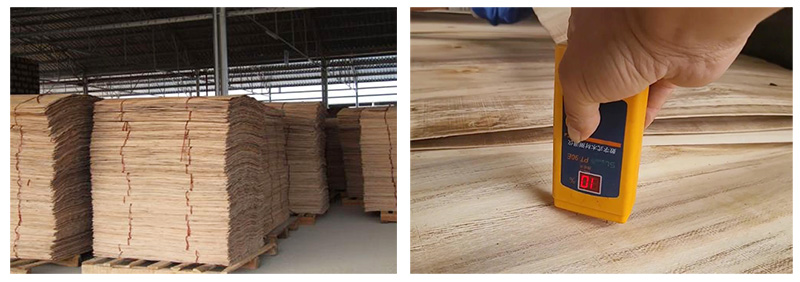
Furthermore, over-dried veneers are prone to "spring-back" and warping. A veneer dried to 0% MC in a wood veneer dryer will aggressively reabsorb moisture from the humid air the moment it exits the machine. In a tropical factory in Mafra, Brazil, a veneer sheet dried to zero can jump back to 10% MC in just a few hours. This rapid re-absorption causes the wood to expand unevenly, resulting in buckling, cupping, and gaps in the final plywood layup. This "yo-yo" effect between extreme dryness and rapid rehydration is far more damaging to dimensional stability than maintaining a steady, moderate moisture level.
So, what is the optimal target? According to international standards and the technical data sheets provided by Shine Machinery, the sweet spot for veneer moisture content lies between 8% and 12%. This range is the gold standard for the global plywood industry. Within this window, the wood is stable, flexible enough to handle without cracking, and possesses just enough residual moisture to assist in the curing of adhesives.
Achieving this specific range consistently is where the sophistication of a modern veneer drying machine becomes critical. It is not merely about blasting hot air; it is about controlled heat transfer and moisture evaporation. A high-quality wood veneer dryer, such as the roller or mesh dryers manufactured by Shine Machinery, utilizes a multi-stage drying process. The initial section employs high temperatures (140°C–180°C) to rapidly remove surface moisture and prevent mold. However, the subsequent sections are carefully modulated. The goal is to bring the core moisture content down to match the surface, ensuring uniformity across the entire sheet.
Uniformity, in fact, is often more important than the average number. If one section of a veneer sheet is at 6% MC and another is at 14%, the plywood panel will inevitably warp during hot pressing. Advanced veneer drying machine models now incorporate real-time moisture scanning technology. These systems use near-infrared sensors to monitor the moisture content across the width of the veneer sheet as it exits the dryer. If a variance is detected, the PLC (Programmable Logic Controller) automatically adjusts the speed of the conveyor or the temperature of specific drying zones. This level of precision ensures that every sheet leaving the wood veneer dryer meets the 8-12% specification.
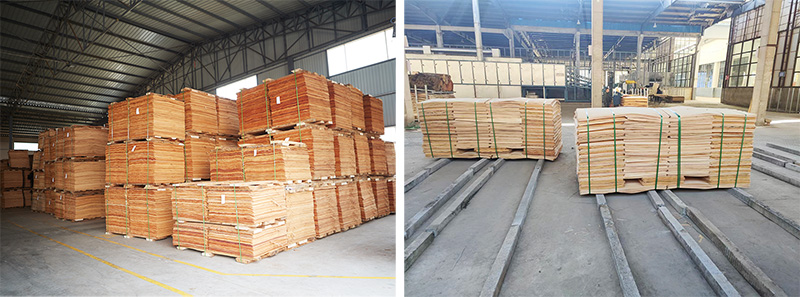
For tropical species like Rubberwood and Eucalyptus, the challenge is compounded by their high density and tendency to collapse under severe drying stresses. Shine Machinery’s engineers emphasize that a modern veneer drying machine must be equipped with a robust hydraulic or pneumatic pressing system. This prevents the veneers from curling at the edges—a common issue with thin 1.5mm to 3mm sheets. By keeping the veneer flat against the heated rollers or mesh belts, the wood veneer dryer ensures maximum thermal contact, which translates to faster drying times and lower energy consumption per cubic meter of output.
The economic implications of moving away from the "0% myth" are significant. By targeting 8-12% MC, factories reduce energy waste. It takes a tremendous amount of thermal energy to remove that last 5% of moisture. By stopping at 10%, a wood veneer dryer can increase its throughput by 15-20%, effectively lowering the cost per sheet. Additionally, the reduction in rejected plywood due to blistering, delamination, or warping directly boosts the bottom line.
Shine Machinery has demonstrated these benefits in various international markets. In their recent installations in South America, the company has focused on educating partners about the importance of the "reconditioning" or "tempering" phase. After the veneers exit the high-heat section of the veneer drying machine, they pass through a cooling and equalization zone. Here, the moisture gradient within the wood evens out. Some facilities even incorporate a brief "steaming" section or a controlled humidity stacking area (a "breather" pile) to allow the sheets to stabilize at the target 10% MC before gluing.
In conclusion, the evolution of the wood veneer dryer is shifting the industry’s focus from mere speed to intelligent precision. The goal is no longer to see how dry a machine can get the wood, but how consistently it can achieve the ideal moisture content for adhesion and stability. As Shine Machinery continues to expand its footprint in Brazil, Peru, and beyond, their message to the market is clear: invest in a veneer drying machine that understands the science of wood. Stop chasing zero; instead, target the 8-12% sweet spot that defines world-class plywood production. For any manufacturer looking to compete in the international market, upgrading to a modern wood veneer dryer that prioritizes uniformity and precision over extreme dryness is not just a technical improvement—it is a strategic business imperative.