

Solving Veneer Roller Dryer Jams
In the high-speed world of plywood manufacturing, the veneer roller dryer stands as one of the most critical—and vulnerable—pieces of equipment on the production floor. For mills processing tropical hardwoods like Brazilian eucalyptus or Thai rubberwood, maintaining a continuous flow through the dryer is essential for hitting daily output targets and preventing the costly onset of blue stain. Yet, even in the most advanced facilities, operators occasionally face a dreaded scenario: a veneer jam inside the roller dryer. When this happens, the difference between a minor hiccup and a major catastrophe often comes down to the operator's training and the clarity of the emergency procedure.
Shine Machinery, a global leader in veneer drying technology with a strong footprint in Asia, Africa, and South America, has released a comprehensive field guide addressing this exact issue. Drawing from over a decade of hands-on experience in troubleshooting dryer installations—from Mafra, Brazil, to industrial hubs in Peru and Southeast Asia—Shine’s engineering team emphasizes that a jam is not just a mechanical failure; it is a test of a factory’s safety culture and operational discipline.
The Immediate Response: Safety First, Always
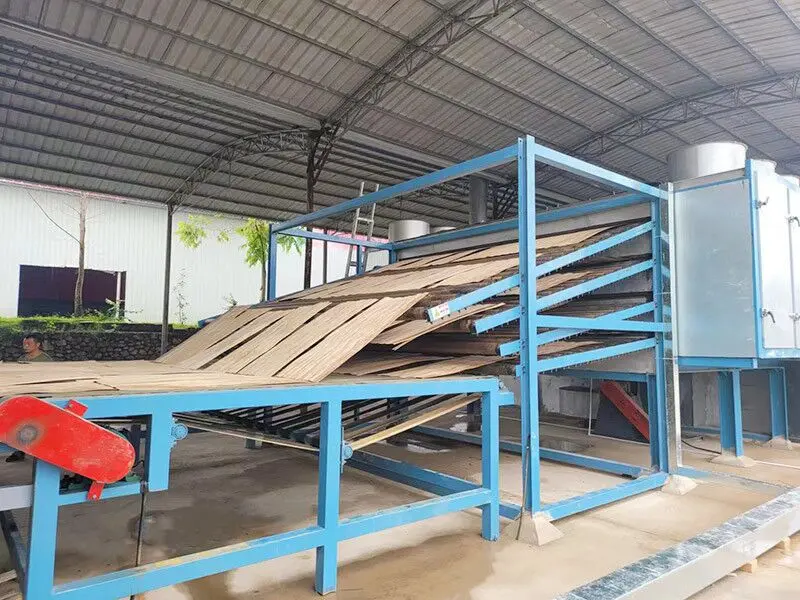
The moment a jam is detected—whether through unusual motor amperage spikes, strange metallic noises, or visible pile-ups at the infeed—the protocol is absolute: stop immediately. "The biggest mistake we see in the field is operators trying to 'inch' the machine forward, hoping to force the jammed veneer through," says a senior engineer at Shine Machinery. "This is extremely dangerous and almost always makes the situation exponentially worse."
According to Shine’s official emergency SOP, the first step is to hit the emergency stop button and cut the main power supply. A Lock-Out Tag-Out (LOTO) procedure must be enforced immediately. "You never work on a dryer without locking the panel and assigning a dedicated safety watchman," the SOP states. This prevents a colleague from accidentally restarting the line while someone is inside the machine.
Next comes the cooling phase. A roller dryer operating at 160–185°C cannot be opened immediately. The internal environment is a severe burn hazard. Shine’s protocol dictates keeping the exhaust fans running for 5 to 15 minutes to ventilate heat and lower the chamber temperature to a safe range. Only then should maintenance personnel, equipped with flame-retardant clothing, insulated gloves, and safety goggles, approach the access doors.
When extracting the jammed veneer, accessing the non-drive side is paramount. "The drive side has chains, sprockets, and high-voltage components. You never reach in there," the guide warns. Technicians should use wooden levers, rubber mallets, or specialized non-sparking hooks to gently coax the material out. Using metal crowbars or chisels is strictly forbidden, as they can scar the hardened surface of the high-temperature rollers, leading to permanent quality defects on future veneer sheets.
Finally, before restarting, a dry-run test of at least 3 to 5 minutes without any material is mandatory. This ensures that no hidden debris remains and that the drive chains and rollers are moving freely.
Why Do Jams Happen? Understanding the Root Causes
To effectively prevent jams, one must understand their origins. In Shine’s analysis of dozens of service calls, the causes of roller dryer jams typically fall into five categories:
Overlapping Veneers: Often caused by poor sorting after the clipper or by wet veneers (above 90% moisture) sticking together. When two sheets enter the roller gap simultaneously, the machine simply cannot process the doubled thickness.
Edge Curling: Particularly common in the first zone of the dryer. If the temperature spikes too high too quickly, the surface of the veneer dries faster than the core, causing the edges to curl upward and wedge into the roller seams.
Roller Gap Mismatch: If the gap between the upper and lower rollers is set narrower than the incoming veneer thickness—often due to mixing different veneer grades—the sheet will get pinched and stuck.
Transmission Failures: A slack chain or a failing pneumatic pressure system can cause one section of rollers to slow down, creating a "traffic jam" as sheets pile up from the faster-moving upstream section.
Contamination: Bark, nails, or dried glue buildup on the rollers creates high spots that catch subsequent sheets.
Prevention: The Shine Machinery Approach
While emergency procedures are vital, Shine Machinery focuses heavily on preventing jams before they start. For tropical wood processors, the company recommends a strict pre-drying sorting process. Veneers with moisture content variations greater than 25% should never be mixed in the same batch.
Furthermore, Shine advocates for a "soft start" temperature profile. Instead of blasting the first zone at maximum heat, operators should maintain a range of 140–160°C for the initial 2 to 3 meters. This allows for gradual moisture release, significantly reducing the risk of edge curl.
Maintenance is also key. Shine advises a daily routine of scraping roller surfaces with bamboo sticks to remove resin buildup, weekly checks on chain tension, and monthly calibrations of roller parallelism. Installing anti-overlap sensors and a manual reject station at the infeed conveyor is also highly recommended. "It’s much cheaper to have a worker kick a bad sheet off a conveyor than to shut down the entire dryer for two hours to clear a jam," notes the Shine team.
A Global Commitment to Operational Excellence
With installations spanning over 30 countries, Shine Machinery understands that the success of a plywood plant relies on more than just selling a wood veneer dryer. It requires a partnership. The company’s turnkey service includes on-site operator training, detailed multilingual manuals, and 24/7 remote technical support.