

Veneer Moisture: The Invisible Plywood Judge
Shine Machinery Reveals How Precise Drying Determines Export-Grade Plywood Quality
In the high-stakes world of global plywood manufacturing, a silent factor dictates whether a factory earns a premium for export-grade boards or suffers devastating losses from rejected shipments. According to leading engineers at Shine Machinery, a global provider of veneer drying solutions, that factor is moisture content. "Veneer moisture is the invisible judge of plywood quality," says the technical team at Shine. "It determines everything from glue strength to dimensional stability. Yet, it remains one of the most misunderstood aspects of the production line."
As the demand for high-quality plywood surges across South America, Southeast Asia, and Africa, Shine Machinery is shedding light on the science behind moisture content. The company emphasizes that achieving the "golden range" of 8%–12% is not just a recommendation—it is a strict requirement for producing structurally sound, internationally compliant plywood.
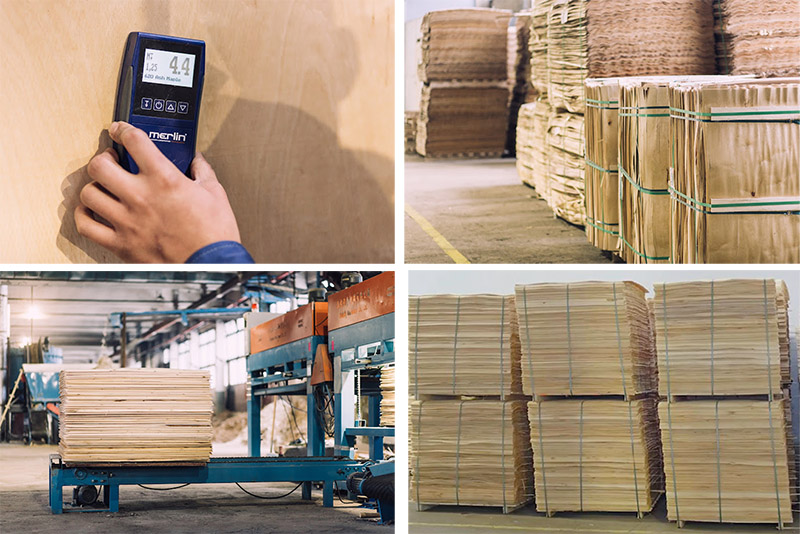
The Danger of Excess: When Moisture Exceeds 15%
The most common quality failure in plywood plants stems from veneers that are too wet. When moisture content climbs above 15%, the risks during the hot pressing stage become severe. As the press platens reach temperatures between 110°C and 140°C, the free water inside the wood cells turns into steam. If the moisture level is too high, this steam builds up intense pressure, violently breaking through the veneer layers and the adhesive film. The result is blistering, bubbling, and catastrophic delamination.
Beyond the steam explosion effect, excessive moisture also dilutes the adhesive. Most urea-formaldehyde and phenol-formaldehyde resins require a specific solids-to-liquid ratio to cure properly. When wet veneers introduce too much water into the glue line, the adhesive becomes too thin, seeping out of the joints or failing to bond the fibers effectively. This leads to "starved glue lines" and a significant drop in bonding strength. Furthermore, wet veneers fail to create sufficient initial tack during the cold pre-press stage, causing the layers to slip and misalign when entering the hot press.
The Myth of "Drier is Better": The Perils of Ultra-Low Moisture
On the opposite end of the spectrum lies a dangerous misconception, particularly prevalent among new operators: the belief that drying veneers to absolute zero is the ultimate goal. This "zero-moisture myth" is actively harmful to plywood quality.
When veneer moisture content drops below 6%—and especially when it approaches 0%—the wood undergoes physical and chemical changes that sabotage adhesion. First, the dry wood acts like a sponge, instantly absorbing the water content from the liquid glue. This leaves the adhesive layer "starved" of its carrier fluid, preventing it from flowing into the wood’s pores to create a mechanical bond. The result is a weak, brittle glue line that fails under stress.
Second, extreme dryness causes surface passivation. At 0% moisture, the cellulose on the veneer surface oxidizes under high heat, creating a slick, chemically inactive layer that resists gluing. Third, the wood itself becomes brittle. As moisture drops from 6% to 0%, the tangential shrinkage rate of hardwood veneers can spike from 5%–9% to as high as 11%. This leads to micro-cracking, edge splitting, and a high rate of breakage during handling and sanding.
The Silent Killer: Non-Uniform Moisture Distribution
Even if the average moisture content is perfect, uneven distribution across a single sheet—or between symmetrical layers—can ruin an entire batch. Shine Machinery’s engineers warn that if one side of a veneer sheet reads 6% while the other reads 14%, the sheet will warp during pressing. This "case hardening" creates internal stresses that cause the finished plywood to cup, bow, or twist as it cools.
In plywood construction, symmetry is the law. Adjacent layers must have perpendicular grain directions and, crucially, matching moisture contents. If the core veneer is dry and the face veneer is wet, the differential shrinkage will create a permanent, irreversible warp. Furniture manufacturers and construction companies receiving these panels will reject them immediately, leading to massive financial losses for the plywood producer.
Shine Machinery’s Solution: Precision in Every Pass
Understanding these critical moisture dynamics, Shine Machinery has engineered its line of wood veneer dryers to eliminate the guesswork. The Shine wood veneer dryer is not merely a heating device; it is a precision climate control system for wood.
Utilizing advanced roller and mesh conveyor designs, Shine dryers subject veneers to a carefully calibrated thermal profile. The initial zone applies moderate heat (140–160°C) to prevent surface cracking, while the main drying zone ramps up to 170–180°C to drive out core moisture efficiently. The final cooling and equalization zone ensures that the moisture gradient within the sheet flattens out, guaranteeing that every veneer exiting the machine hits the 8%–12% target with an intra-sheet deviation of less than ±2%.
This level of precision directly translates to superior plywood. By feeding a hot press with perfectly conditioned veneers, manufacturers can increase their first-pass yield rate to over 95%, drastically reduce energy consumption per cubic meter, and command higher prices in the export market.
A Global Commitment to Quality
With successful installations in Brazil, Peru, Thailand, and across Africa, Shine Machinery is more than just an equipment supplier; it is a partner in quality assurance. The company’s turnkey solutions include on-site installation, operator training, and 24/7 technical support, ensuring that clients can master the art and science of veneer moisture control.
"For any plywood producer looking to compete globally, the message is clear," concludes a Shine spokesperson. "You cannot inspect quality into a product at the end of the line; you have to build it in at the drying stage. By respecting the 'invisible judge' of moisture content, manufacturers can ensure every sheet of plywood that leaves their factory is a testament to durability and precision."
For more information on how Shine Machinery’s veneer dryer technology can optimize your plywood production, contact their international sales team today.