

Can You Add Sensors Inside Dryers?
In the modern wood processing industry, the quest for higher efficiency, lower energy consumption, and consistent product quality has driven manufacturers to embrace automation. One of the most frequently asked questions by plywood producers looking to upgrade their operations is whether they can retrofit their existing veneer drying machine with internal humidity and temperature sensors. The answer is a resounding yes—and it is not only possible but highly recommended for any factory aiming to stay competitive. Adding these sensors transforms a conventional dryer from a manually adjusted heat chamber into a smart, self-regulating system capable of optimizing fuel use and guaranteeing uniform moisture content in the final veneer.
The concept of installing sensors inside a roller veneer dryer or any other type of veneer drying machine is rooted in the need for precise environmental control. During the drying process, veneer sheets are exposed to high temperatures and rapidly changing humidity levels. Without accurate real-time data, operators are forced to rely on experience, guesswork, or infrequent manual checks, which often lead to over-drying, under-drying, or excessive energy waste. By integrating industrial-grade temperature and humidity sensors directly into the drying chamber, manufacturers can monitor conditions continuously and make instantaneous adjustments. This shift from reactive to proactive management is the cornerstone of modern drying technology.

Temperature sensors are the most straightforward and mature component of such a retrofit. Inside a roller veneer dryer, the environment can be harsh, with temperatures often ranging between 120°C and 200°C depending on the adhesive and wood species. Standard electronic sensors would fail quickly under such conditions. Therefore, high-temperature resistant models, such as PT100 platinum resistance thermometers enclosed in stainless steel protective sheaths or K-type thermocouples, are used. These devices provide accurate readings even at elevated temperatures and can be installed in critical zones: the preheating section, the main drying section, and the balancing section. The data collected is fed into a programmable logic controller (PLC), which automatically modulates the burner’s fuel valve to maintain the desired setpoint. This closed-loop control keeps temperature fluctuations within a narrow band, typically ±2°C, ensuring that the veneer is dried uniformly without thermal degradation.
Humidity sensors, while equally important, present a greater technical challenge. The interior of a veneer drying machine is characterized by extreme humidity—often approaching saturated steam conditions—as moisture evaporates from the wood. Additionally, the air is laden with fine wood dust and volatile resins, which can coat sensor surfaces and cause inaccurate readings or premature failure. To withstand these conditions, manufacturers must select specialized industrial sensors. Capacitive polymer sensors, which are common in low-temperature applications, are unsuitable here. Instead, high-temperature humidity transmitters with sintered stainless steel dust filters and Teflon-coated membranes are employed. These rugged devices resist clogging and chemical attack, providing reliable relative humidity or dew point measurements. Installation locations are carefully chosen, typically near the exhaust vents or in the mid-section of the dryer, where airflow is representative of the overall chamber conditions without being directly exposed to excessive condensate dripping.
The true power of adding these sensors lies in their ability to enable intelligent exhaust management. In a traditional veneer drying machine, exhaust fans often run continuously to remove moist air, but this practice also expels large amounts of valuable heat. By linking the exhaust dampers to real-time humidity sensor data, the system can operate on demand: the fans activate only when the internal humidity exceeds a preset threshold and shut off once the moisture level drops to the target range. This simple yet effective strategy can reduce heat loss by 10% to 20%, translating into substantial fuel savings over a production season. For a medium-sized plywood mill, this could mean thousands of dollars saved annually, not to mention a reduction in carbon emissions that aligns with global sustainability goals.
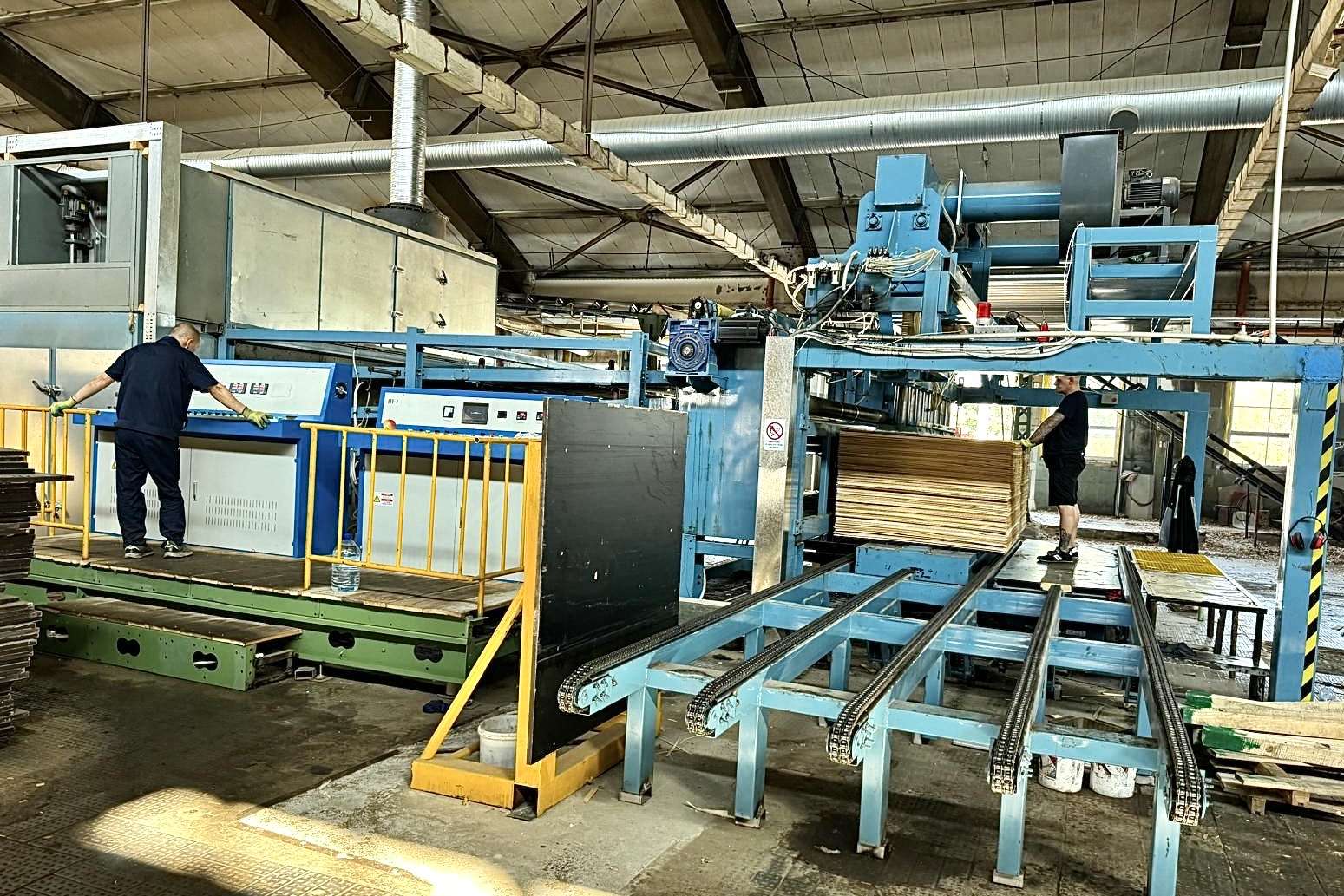
Beyond energy savings, sensor integration significantly improves product quality. Inconsistent drying leads to veneer sheets with varying moisture contents, which can cause warping, cracking, or poor bonding in subsequent pressing stages. With internal sensors providing a complete picture of the drying environment, the PLC can adjust conveyor speed, fan speed, and temperature profiles dynamically. For instance, if the sensors detect a sudden drop in humidity due to a change in ambient weather, the system can compensate by slightly increasing the burner output or slowing down the feed rate. This level of responsiveness ensures that every sheet of veneer emerges from the dryer within the optimal moisture window, typically 8% to 12%, ready for high-grade plywood production.
Another advantage of retrofitting sensors is the ability to implement predictive maintenance and fault diagnosis. A sudden deviation in temperature readings might indicate a malfunctioning burner, a clogged heat exchanger, or a failure in the fuel supply system. Similarly, if the humidity fails to decrease as expected, it could signal a blocked exhaust duct, a reversed fan rotation, or a leak in the insulation. Modern control systems can display these anomalies on a human-machine interface (HMI) touchscreen and even send remote alerts to supervisors via IoT connectivity. This early warning capability minimizes unplanned downtime and extends the lifespan of the equipment by preventing catastrophic failures.
When planning a sensor retrofit for a roller veneer dryer, several practical considerations must be addressed. First, all internal sensors should be housed in protective tubes or guards to shield them from physical damage caused by moving veneer sheets or flying debris. Second, because the sensors operate in a high-temperature, high-humidity environment, regular maintenance is essential. A schedule of cleaning the sensor probes with compressed air every one to two weeks is recommended to remove dust and resin buildup that could affect accuracy. Third, signal transmission from the sensors to the control cabinet should use 4-20mA current loops rather than voltage signals, as current signals are less susceptible to electromagnetic interference over long distances. Finally, it is crucial to select sensors with appropriate measurement ranges and accuracy ratings; for example, a humidity sensor with a range of 0% to 100% RH and an accuracy of ±2% is typically sufficient for drying applications.
The economic justification for such an upgrade is compelling. The initial cost of industrial sensors, protective hardware, and PLC integration is relatively modest compared to the overall value of the drying line. The return on investment is realized through multiple channels: reduced fuel consumption, lower labor costs (as manual inspections are minimized), decreased reject rates, and increased throughput due to optimized drying cycles. In many cases, the payback period is less than a year. Moreover, the ability to provide documented proof of consistent drying conditions can be a selling point when negotiating with quality-conscious buyers, particularly in export markets where stringent standards apply.
Looking ahead, the integration of sensors is just the first step toward fully intelligent drying. Future advancements may include wireless sensor networks that eliminate the need for cumbersome cabling, or the use of artificial intelligence to predict drying curves based on wood species, initial moisture content, and thickness. Some manufacturers are already experimenting with near-infrared (NIR) sensors that measure the moisture content of the veneer itself as it exits the dryer, creating a closed-loop system that adjusts the drying parameters for the next batch. As these technologies mature, the humble veneer drying machine will evolve into a highly sophisticated component of the smart factory.
In conclusion, adding humidity and temperature sensors inside a roller veneer dryer is not only feasible but essential for any wood processing enterprise serious about efficiency and quality. The technology is mature, the benefits are well-documented, and the implementation is straightforward with the right engineering support. By taking this step, manufacturers can unlock significant energy savings, improve product consistency, and position themselves at the forefront of the industry’s digital transformation. Whether retrofitting an older machine or specifying a new line, the message is clear: sensors are the key to unlocking the full potential of the veneer drying process.