

Why Your Perfectly Dried Veneers Re-Wet?
For any plywood or LVL manufacturer, the sight of perfectly dried wood veneers emerging from the veneer drying machine is a moment of pride. The heat exchanger is humming, the moisture content (MC) reads a stable 8%, and the sheets are flat and warm. Yet, hours later, when the crew returns to load the hot press, the veneers feel damp, limp, and warped. What happened? You didn’t just lose heat; you lost the battle against wood’s natural tendency to seek equilibrium.
This phenomenon, often called "moisture rebound" or "re-wetting," is one of the most costly and misunderstood issues in wood processing. It’s not necessarily a sign that your veneer drying machine failed; rather, it’s a failure to manage the physics of wood and the environment of your factory. To solve it, we must look beyond the dryer itself and examine the transition from the heat exchanger to the storage rack.
The Physics of Thirst: Wood’s Hygroscopic Nature
Unlike synthetic materials, wood is hygroscopic. It breathes. It constantly exchanges moisture with the surrounding air in an attempt to reach a state of balance known as the Equilibrium Moisture Content (EMC). Think of it as wood’s "comfort level."
If your wood veneers exit the dryer at 8% MC and enter a factory environment with 80% Relative Humidity (RH)—a common scenario during monsoon seasons or in tropical climates—the wood is deeply uncomfortable. It is drier than the air around it. Physics demands that the wood absorbs moisture from the air until it reaches the EMC dictated by that environment (which could be 15% or higher). This process begins the instant the veneer leaves the heat exchanger zone.
The Two Fronts of Failure: Process and Environment
While the physics are constant, the severity of moisture rebound usually stems from two main areas: incomplete drying mechanics and poor post-drying handling.
1. The "Core Moisture" Problem (Process Failure)
In our previous discussions regarding the efficiency of finned tube heat exchangers, we emphasized the importance of uniform heat transfer. However, if the drying process is rushed—perhaps to chase higher hourly outputs—a phenomenon known as "case hardening" can occur.
When the surface of the veneer is blasted with high heat too quickly, it dries, shrinks, and forms a hard, impermeable skin. Meanwhile, the core of the veneer remains wet. Because the surface is sealed, this internal moisture is trapped. Once the wood veneers leave the veneer drying machine, the trapped core moisture migrates outward. This internal "sweating" causes the veneer to buckle, check, and feel damp days later. It is a ticking time bomb created by thermal imbalance.
2. The "Cold Shock" and Storage Failure (Environmental Failure)
Even if the veneers are dried perfectly, they are extremely vulnerable to "Cold Shock." Hot veneers exiting a veneer drying machine at 100°C+ are magnets for atmospheric moisture. If these hot sheets are stacked immediately in a cool, humid warehouse, the moisture in the air condenses on the veneer surface instantly—much like water droplets forming on a cold glass of soda.
Furthermore, improper storage compounds the problem:
Concrete Wick Effect: Stacking dried wood veneers directly on concrete floors. Concrete never truly dries and acts as a wick, pulling ground moisture up into the bottom layers of your stack.
The "Plastic Wrap" Trap: Covering damp veneers with non-breathable membranes (like certain plastics) traps evaporating moisture, creating a high-humidity microclimate that rehydrates the wood.
Lack of Airflow: Stacking veneers without "stickers" (spacers) prevents air circulation, allowing humid air to stagnate between the sheets.
The Solution: Creating a "Transition Zone"
Preventing moisture rebound requires a holistic approach that extends beyond the exit of the heat exchanger. You must create a controlled transition from the dryer to the press.
1. Implement a Cooling Zone
Modern veneer drying machines, such as those engineered by Shine, integrate a cooling section at the end of the tunnel. This is not just for worker safety; it is a critical stabilization phase. Gradually reducing the temperature of the wood veneers to within 10-15°C of the ambient factory temperature prevents "Cold Shock" and allows the fibers to stabilize before storage.
2. Buffer Room Storage
Do not send hot veneers directly into a cold, damp warehouse. Establish a "conditioning room" or buffer zone. This area should be climate-controlled to maintain a stable temperature (20-25°C) and a moderate RH (50-60%). The goal is to keep the environmental EMC slightly lower than your target veneer MC (8%). This ensures the wood stays dry or continues to lose moisture slowly, rather than absorbing it.
3. The Art of Stacking
How you stack your veneers is as important as how you dry them.
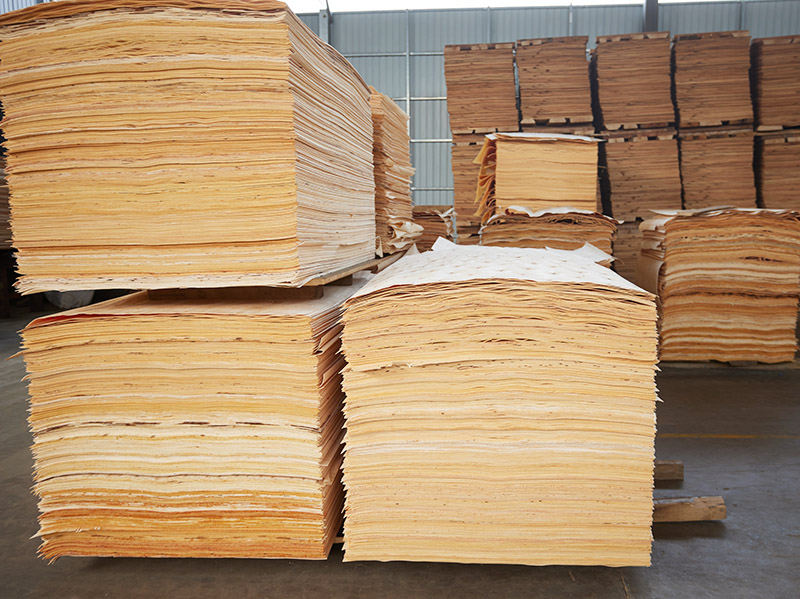
Use Stickers: Always place thin, dry wooden strips (stickers) between layers of veneers. This creates air channels that allow residual heat and moisture to escape.
Elevate: Keep veneers on pallets, at least 6 inches off the concrete floor.
Smart Covering: Use breathable covers or vapor barriers that are sealed at the edges to lock out ambient humidity while allowing the wood to breathe.
4. Monitor Relentlessly
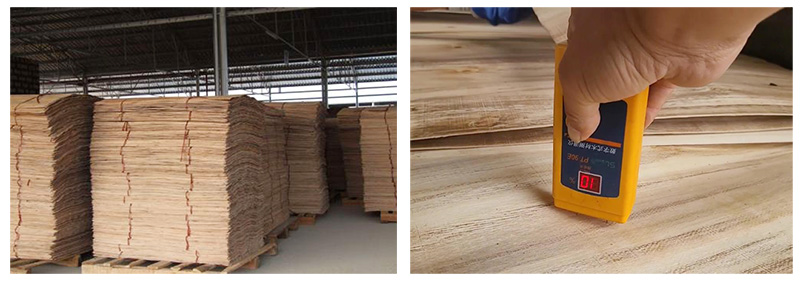
Install hygrometers (humidity sensors) in your storage areas. Don't just trust the sensors on your veneer drying machine. Track the EMC of the air where your profits are sitting. If the RH climbs above 65%, activate dehumidifiers or adjust your HVAC systems immediately.
Conclusion: Protecting Your Investment
Your heat exchanger works tirelessly to remove water; your storage practices must work just as hard to keep it out. Moisture rebound is not an inevitable consequence of wood processing; it is a symptom of environmental neglect. By understanding the science of EMC and implementing disciplined cooling and storage protocols, you ensure that the quality achieved inside the veneer drying machine is preserved all the way to the hot press. This diligence protects your raw material investment, ensures glue-line integrity in your final products, and solidifies your reputation for producing premium, dimensionally stable plywood and LVL panels. In the world of wood processing, the battle against moisture never ends—but with the right knowledge, it is a battle you can win.