

Dried Veneer’s Next Life
Once veneer leaves the dryer at the right moisture level—usually 8%–12% for plywood core stock and a tighter 6%–10% for decorative or engineered veneer—the real manufacturing value chain begins. Drying is only the preparation step. A sheet that comes out of a mesh belt veneer dryer or roller veneer dryer is still just thin wood. What happens next decides whether it becomes cheap packing material, structural plywood, furniture face stock, or a high-end architectural surface.
The first deep-processing step is grading and defect control. Dried sheets are stacked, inspected, and separated by visual quality, thickness, flatness, and moisture uniformity. Face and back veneers—those with clean grain, uniform color, and no open defects—are routed toward visible surfaces. Core veneers with knots, small splits, or color variation go inward, where appearance does not matter but dimensional stability does. In modern plants, this is no longer purely manual. Inline moisture scanners, AI visual sorters, and width/clipping lines classify sheets so the lay-up operator never has to guess. A sheet dried badly will fail here; a sheet dried well becomes a premium asset.
After grading comes repair and composition. Narrow ribbons from the peeling lathe are joined into full sheets by scarf jointing, finger jointing, or tapeless splicing machines. Holes, worm tracks, and edge tears are patched with matching wood filler or punched-and-plugged repair blanks. For decorative lines, strips are composed into flitch-matched layouts: bookmatch, slipmatch, radial match, or sequenced panels for hotel lobbies and luxury cabinetry. Engineered veneer takes this further—dyed strips are reassembled into blocks, sliced again, and turned into uniform “fine-line” or reconstituted faces that look like walnut, ebony, or teak without depending on rare logs.
Then comes gluing. Dried veneer is run through roller glue spreaders, curtain coaters, or extrusion gluing systems. Core veneers receive adhesive on both sides; face veneers are often kept unglued on the show side to avoid bleed-through. Urea-formaldehyde is common for interior furniture plywood, phenol-formaldehyde or WBP systems for exterior, marine, and concrete-formwork plywood, and low-formaldehyde or MDI-type adhesives for export panels targeting CARB, EPA, or E0/E1 compliance. Glue dosage matters: too little means starved glue lines and delamination; too much means panel weight, formaldehyde risk, and bleed marks under lacquer. A veneer that left the dryer at 10% moisture glues predictably. A sheet at 4% or 18% fights the adhesive and ruins the press cycle.
Lay-up is where structure is designed. Veneers are stacked so adjacent plies run at 90 degrees—cross-banding—which is the whole reason plywood exists. Odd numbers of plies keep the panel balanced: 3-ply for light furniture board, 5-ply and 7-ply for doors and architectural panels, 9-ply and above for truck flooring, container flooring, and marine structures. High-grade face veneer sits outside; sound but cheaper veneer sits inside. For LVL and beam stock, many thin plies are stacked in one grain direction to maximize bending strength. For decorative wall panels, a single beautiful face veneer is laminated onto MDF, particleboard, or plywood substrate. The dryer’s job was to make sure none of these layers move, cup, or crack during pressing.
Cold pressing comes next. The laid-up pack enters a cold press at 0.8–1.0 MPa for 15–20 minutes. This consolidates the stack, drives out trapped air, prevents ply shift, and begins the gel phase of the adhesive. Plants that skip or rush cold pressing often see “telephone cord” gaps, misaligned plies, and face bleed in the hot press. Cold pressing is low drama but high consequence: it turns a loose sandwich into a coherent board.
Hot pressing is the heart of the process. Under 110–150°C and several kilograms per square centimeter of pressure, thermosetting resin crosses links and locks the veneer plies into one rigid panel. Phenolic systems need more heat and time; urea systems cure faster but resist less water. Press time scales with thickness: an 18 mm panel may stay under the platens 7–10 minutes, while a 4 mm decorative panel may need only a couple of minutes. After ejection, panels are too hot and internally stressed to handle roughly. They move to cooling decks or turning racks, where residual heat dissipates and moisture equalizes. Premature trimming here causes spring-back and edge wave.
Post-press processing turns the cured slab into a sellable product. Wide-belt calibrating sanders bring the panel to exact thickness—often ±0.3 mm for calibrated plywood. Double-end trimmers cut it square to 1220×2440 mm, 1250×2500 mm, or custom architectural sizes. Putty stations fill face knots and splits so defects do not telegraph through melamine, HPL, or phenolic film. Then comes the value-adding loop: film-facing for concrete formwork, melamine impregnation for cabinetry, HPL bonding for lab and shopfit panels, UV basecoat and lacquer for furniture faces, edge sealing with moisture-blocking paint, and barcode/traceability stamping for export markets.
Application scenarios decide how far deep processing goes. For construction plywood, the goal is structural integrity: cross-banded plies, WBP glue, sanded or film-faced surfaces, reusable concrete form faces. For furniture and cabinetry, the dried veneer itself is the product hero—oak, walnut, teak, reconstituted poplar, or fine-line eucalyptus—laminated onto substrate, sanded to 150–220 grit, stained, lacquered, and bookmatched across wardrobe fronts. For doors and wall panels, veneer is composed for pattern continuity across large surfaces; a hotel corridor may require fifty door leaves with near-identical grain flow. For container flooring and truck bodies, dried hardwood veneer is pressed with phenolic resin into extremely dense, impact-resistant board. For decorative architectural interiors, engineered veneer is cut, joined, backed, pressed, sanded, and finished until it reads as solid timber but performs better than solid timber.
A good example is a furniture panel plant. Rotary-cut rubber wood or poplar veneer is dried to about 9% moisture, graded A/B/C, patched, glued with E1 urea resin, laid up as 5-ply, cold pressed, hot pressed at 125°C, cooled overnight, sanded, and then a 0.5 mm decorative veneer—natural or engineered—is laminated onto the surface in a second press. The base plywood gives stability; the face veneer gives price. Without correct drying upstream, the decorative face later blisters, the MDF substrate shows through, or the panel twists in the customer’s warehouse.
Another example is film-faced plywood for construction. Dried hardwood core veneer is glued with phenolic resin, pressed, cooled, sanded, then sent through a film-overlay press where phenolic-impregnated paper bonds to both faces. The result withstands dozens of concrete pours. Here, deep processing is less about beauty and more about chemical durability: waterproof glue, closed surface, sealed edges, repeated demolding without delamination.
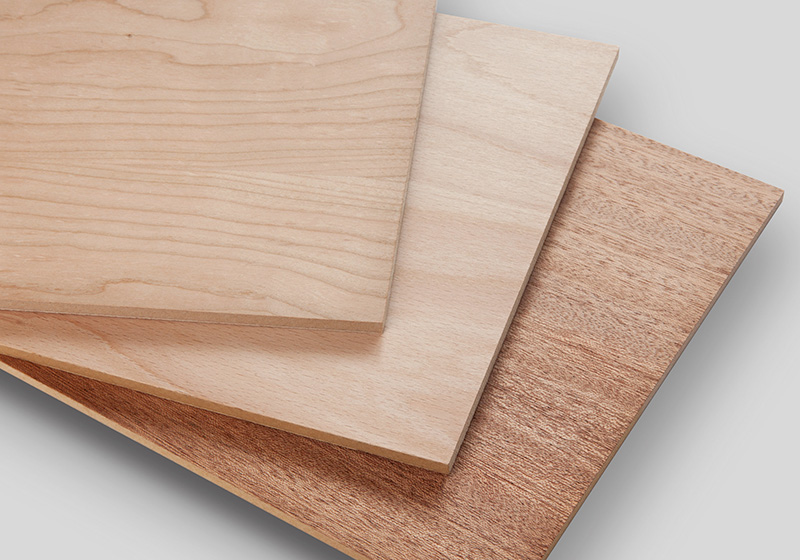
Engineered veneer adds yet another layer. After dyeing and重组, the sliced sheet is dried gently, composed into full sheets, laminated onto substrate, sanded carefully—aggressive sanding destroys pearlescent or figured surfaces—then finished with sealer, basecoat, and topcoat. Applications range from yacht interiors and aviation cabins to retail fit-out and luxury residential wall cladding. The dryer for this segment must be gentle; the downstream process must be cleaner than ordinary plywood work.
In short, dried veneer does not simply “become plywood.” It becomes whatever the market pays for. Core stock becomes invisible structure. Face stock becomes the reason a buyer chooses one cabinet over another. Engineered veneer becomes brand identity for hotels, offices, and high-end residences. Repair, splicing, gluing, cross-band lay-up, cold press, hot press, calibration, trimming, overlaying, finishing, and grading are the stages that convert a fragile wood ribbon into a engineered panel with predictable strength, stable dimensions, and real commercial value.
For equipment suppliers, the lesson is clear: a veneer dryer should never be sold as an isolated machine. It is the first domino. If the sheet leaves the dryer with uniform moisture, flat geometry, and undamaged surface, every downstream machine—spreader, composer, cold press, hot press, sander, laminator—runs better. If it leaves too dry, too wet, or too curly, the whole factory pays downstream: more patching, more glue, more rejection, more claims. Drying prepares the wood; deep processing creates the product; the application defines the price.
That is why Shine Machinery keeps telling customers: do not ask only “how fast can the dryer run.” Ask “what will this veneer become?” A 0.4 mm engineered walnut face for a Dubai hotel is not the same animal as a 2.5 mm rubber wood core for a Chinese construction-plywood mill. Same word—veneer—very different journey after the dryer.
From peeler to panel, the dried sheet is no longer just wood. It is inventory, structure, surface, brand, and margin—all at once. The dryer sets the ceiling; deep processing decides how close the factory gets to it.