

Why Roller Dryers Need Thickness Limits
In the wood processing industry, selecting the right veneer drying equipment is a decision that directly impacts product quality, operational efficiency, and ultimately, profitability. Among the various types of drying machines available, the roller veneer dryer is often praised for its excellent flattening effect and high-speed production capabilities. However, experienced manufacturers and operators know that this powerful machine comes with a specific operational boundary: it is predominantly recommended for drying veneers with a thickness of 0.8mm and above. While it might seem like an arbitrary number, this threshold is rooted in the fundamental physics of heat transfer, material mechanics, and mechanical engineering. Understanding why roller dryers struggle with thinner sheets—specifically those below 0.8mm—is crucial for making informed investment decisions and avoiding costly production pitfalls.
The Mechanics of the Roller Dryer: A Double-Edged Sword
To understand the limitation, one must first understand how a roller dryer works. Unlike mesh belt dryers that support veneers from underneath across their entire surface, roller dryers use a series of upper and lower steel rollers. The veneer is "sandwiched" between these rollers, which serve two primary functions: they transport the sheet through the drying chamber and, more importantly, apply pressure to flatten the wood fibers. This contact pressure is precisely why roller dryers produce veneers with superior flatness and a smooth, polished surface, making them ideal for high-grade plywood and LVL production.
However, this same pressure becomes problematic when dealing with ultra-thin veneers. A typical roller has a diameter of 89mm to 102mm. When a sheet of veneer thinner than 0.8mm—especially one with a high moisture content—enters the nip point between two rollers, it lacks the structural rigidity to withstand the weight and the frictional grip. The wet wood acts less like a solid sheet and more like a damp cloth. Under the weight of the upper roller, the veneer can deform, creating permanent press marks or "roller marks" that ruin the surface quality. For decorative veneers where aesthetics are paramount, this defect alone renders the product unsalable.
The Problem of "Falling Through the Cracks"
Another significant mechanical challenge is the spacing between the rollers. In a roller dryer, the distance between the centers of two consecutive rollers—known as the pitch—is designed to support thicker, stiffer sheets. When a veneer thinner than 0.8mm enters the machine, its flexibility allows it to sag or "belly" between the rollers. This sagging is exacerbated by the high-velocity hot air jets used for convection drying. Instead of lying flat and moving linearly, the thin sheet can flutter, fold, or even wrap around the rollers.
This leads to catastrophic jams. A thin, wet veneer that gets caught in the machinery can cause the entire production line to seize. Clearing these jams is not only time-consuming—often taking 30 minutes to an hour—but also risks damaging the equipment. In contrast, thicker veneers (1.0mm and above) possess enough inherent stiffness to bridge the gaps between rollers, maintaining their flat orientation and ensuring a smooth, uninterrupted flow through the drying chamber.
Thermal Dynamics: The Risk of Over-Drying
Beyond mechanical handling, the thermal interaction between the roller and the veneer presents another limitation for thin sheets. Roller dryers utilize a combination of convection (hot air) and conduction (contact with the hot steel rollers). The rollers themselves are heated, often to temperatures between 140°C and 170°C. When a thick veneer (e.g., 2.0mm) comes into contact with a hot roller, the heat penetrates slowly, and the moisture has time to migrate from the core to the surface.
For a veneer thinner than 0.8mm, the dynamics change drastically. The thermal mass of the steel roller is enormous compared to the thin wood sheet. The heat transfer is almost instantaneous. If the dryer is running at standard speeds for thicker stock, a thin veneer will reach its target moisture content in a fraction of the time. If the line speed is not significantly increased to compensate, the veneer will quickly surpass the target moisture content of 8%–12% and become over-dried. Over-dried veneers are brittle, leading to snapping during handling and a significant increase in waste. Conversely, if the line speed is increased to match the drying rate of the thin veneer, the production efficiency advantage of the roller dryer is negated, and the cost per cubic meter rises.
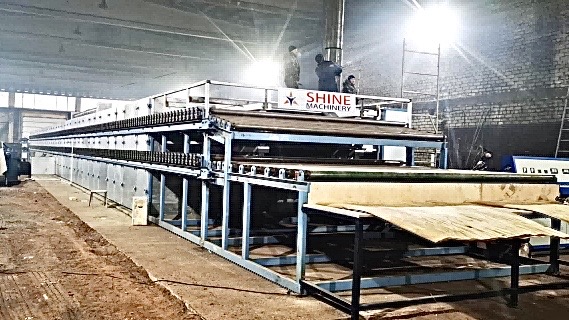
Surface Integrity and Species Sensitivity
The issue is further complicated by the type of wood being processed. Fast-growing species like eucalyptus, rubberwood, and Acacia mangium are staples in many plywood mills. These woods are known for being relatively soft and fibrous when green. When a thin sheet of eucalyptus (e.g., 0.5mm) is pulled through a roller dryer, the tensile forces exerted by the rollers can cause the wood fibers to separate at the edges, resulting in "feathering" or tearing. This is particularly true if the veneer has minor defects or if the knives in the peeling line were not perfectly sharp.
Furthermore, the high-temperature contact can cause "case hardening" on thin sheets. This occurs when the surface of the wood dries and hardens too quickly, forming a seal that traps moisture inside. Because the veneer is so thin, the internal stress caused by this uneven drying leads to severe warping and curling, completely defeating the primary purpose of using a roller dryer for flattening.
The Superior Alternative: Mesh Belt Dryers
So, what is the solution for drying veneers thinner than 0.8mm? The industry standard shifts towards Mesh Belt Veneer Dryers or Wire Mesh Conveyor Dryers. These machines operate on a fundamentally different principle. Instead of being pinched between rollers, the veneer rests on a continuous, permeable mesh belt. Hot air is blown vertically through the belt and the veneer. This method offers several advantages for thin sheets:
Full Support: The mesh belt provides continuous support across the entire surface of the veneer, preventing sagging and ensuring it remains flat.
No Pressure Marks: Since there is no contact pressure from heavy steel rollers, there is zero risk of press marks or roller imprints.
Gentle Handling: The veneer is transported smoothly without the tensile stress of being pulled through roller nips.
Uniform Airflow: Vertical airflow ensures even heat distribution, which is critical for preventing warping in thin sheets.
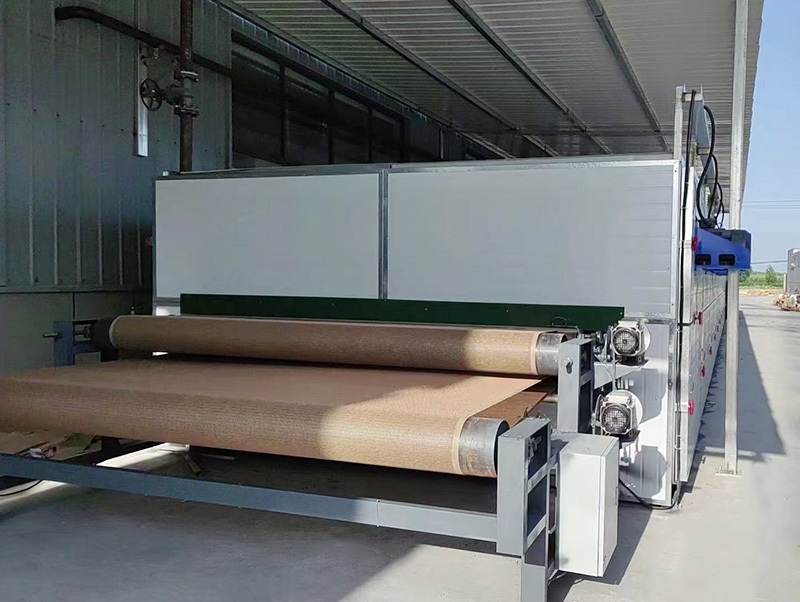
For decorative veneers, which are often sliced to thicknesses of 0.2mm to 0.6mm, the mesh belt dryer is not just an alternative; it is the only viable option for achieving commercial-grade quality.
Conclusion: Matching the Machine to the Material
In conclusion, the 0.8mm thickness limit for roller veneer dryers is not an arbitrary figure imposed by manufacturers to limit their market. It is a practical boundary defined by the laws of physics and material science. The very features that make roller dryers excellent for thick veneers—contact pressure for flattening and high-temperature conduction for speed—become liabilities when applied to thin, flexible, and fragile sheets.
For plywood producers focused on core veneers and thicker face veneers, the roller veneer dryer remains the king of efficiency and flatness. However, for those venturing into the realm of decorative surfaces, flexible plywood, or working with ultra-thin sheets, recognizing this limitation is the first step toward selecting the right equipment. By choosing a mesh belt dryer for thin stock and reserving the roller dryer for its 0.8mm+ sweet spot, manufacturers can optimize their production lines, minimize waste, and ensure the highest possible quality across their entire product range. Investing in the right technology for the specific thickness is not an expense; it is a strategic move to protect your profit margins and your reputation in a competitive global market.