

Is Your Veneer Dryer Truly Efficient?
In the competitive world of wood processing, thermal efficiency is not just a technical metric—it is the backbone of profitability. For manufacturers operating a veneer dryer, the ability to lock heat inside the drying chamber, deliver it precisely to the veneer surface, and minimize waste directly determines fuel costs, output quality, and environmental compliance. Yet, many factories continue to lose thousands of dollars each year through invisible thermal leaks, poorly designed airflow, and outdated control systems. Understanding how to maximize the thermal efficiency of a veneer drying machine has therefore become a critical priority for plywood producers, veneer mills, and exporters who want to stay ahead in the global market.
The foundation of thermal efficiency lies in insulation. A veneer dryer is essentially a high-temperature enclosure where hot air circulates to evaporate moisture from wood veneer. If the chamber is not properly sealed and insulated, a significant portion of the generated heat escapes through the walls, roof, and especially the doors. Industry studies indicate that door-related heat loss alone can account for up to 20% of total thermal waste. This is why leading manufacturers like Shine Machinery have invested heavily in advanced door insulation systems, utilizing aluminum silicate fiber blankets with densities between 80 and 100 kg/m³, combined with vapor barriers and high-temperature silicone seals. Such designs reduce door heat loss by more than 60% and eliminate cold spots near the entrance, ensuring a uniform temperature profile across the entire chamber. When the insulation performs well, the outer panel surface remains close to ambient temperature, which not only saves energy but also improves workplace safety by reducing burn risks.
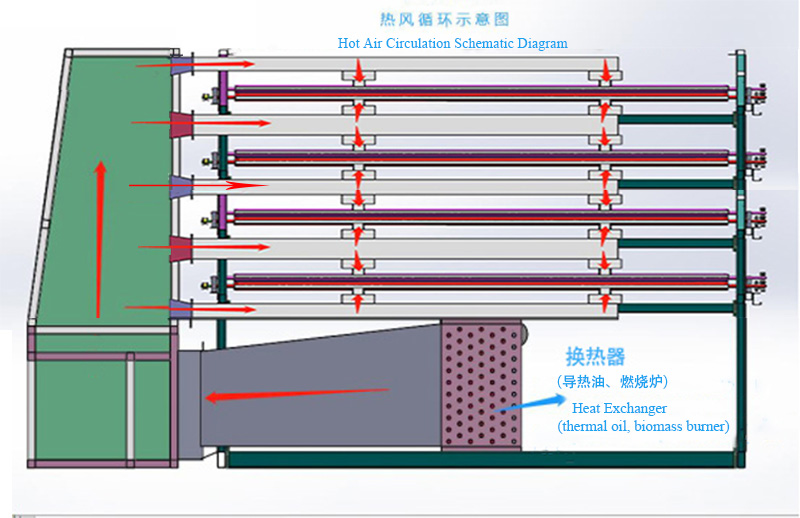
Beyond insulation, airflow distribution plays an equally vital role in determining how effectively heat is transferred to the veneer. A common misconception is that higher temperatures alone guarantee faster drying. In reality, if hot air does not reach the veneer surface uniformly, some areas will over-dry while others remain wet, leading to warping, cracking, and inconsistent moisture content. Modern veneer drying machines employ carefully engineered nozzle systems and plenum chambers to create even air velocity across the veneer width. The ideal design ensures that the velocity variation between nozzles does not exceed 15%. Cross-directional airflow, where hot air is blown alternately from upper and lower jets, enhances penetration and heat exchange. Additionally, the circulation fans must be maintained at peak efficiency; accumulated dust on fan blades can reduce airflow by 10% to 20%, forcing the burner to work harder to compensate. Regular cleaning and balancing of fans are therefore essential maintenance tasks that directly impact thermal performance.
The combustion and heat exchange system represents the source of all thermal energy in the dryer. An efficient veneer making machine line includes a well-tuned burner and heat exchanger. Proportional-control burners, which automatically adjust flame intensity based on the set temperature, prevent the energy waste associated with frequent on-off cycling. Equally important is the cleanliness of the heat exchanger surfaces. A layer of soot or dust just 1 mm thick can reduce heat transfer efficiency by 5% to 8%. Monthly inspection and cleaning of the exchanger should be a standard operating procedure. Furthermore, waste heat recovery systems can capture thermal energy from exhaust gases to preheat incoming fresh air or provide warm water for other plant processes, recovering up to 15% of otherwise lost energy. For factories in regions with high energy costs, switching to biomass burners or natural gas with high combustion efficiency can also yield substantial savings.
Operational practices are the human factor that can make or break thermal efficiency. Even the best veneer dryer will underperform if operated incorrectly. One key practice is matching the infeed speed to the drying temperature. Feeding veneer too quickly results in under-dried sheets, while feeding too slowly wastes heat on an empty chamber. Experienced operators find the optimal rhythm where the machine runs at near full capacity without causing jams. Another critical factor is moisture sorting. Veneers with widely different moisture contents should be dried in separate batches. Mixing very wet and moderately wet sheets forces the dryer to operate at higher temperatures and longer residence times, wasting fuel on the already-dry sheets. The preheating zone should be set 10°C to 20°C lower than the main drying zone to prevent surface case-hardening, which traps interior moisture and prolongs drying time. Finally, the exhaust damper must be modulated based on real-time humidity readings rather than being left fully open. Excessive exhaust ventilation blows away valuable heat along with the moisture, a mistake that can increase fuel consumption by 10% to 20%.
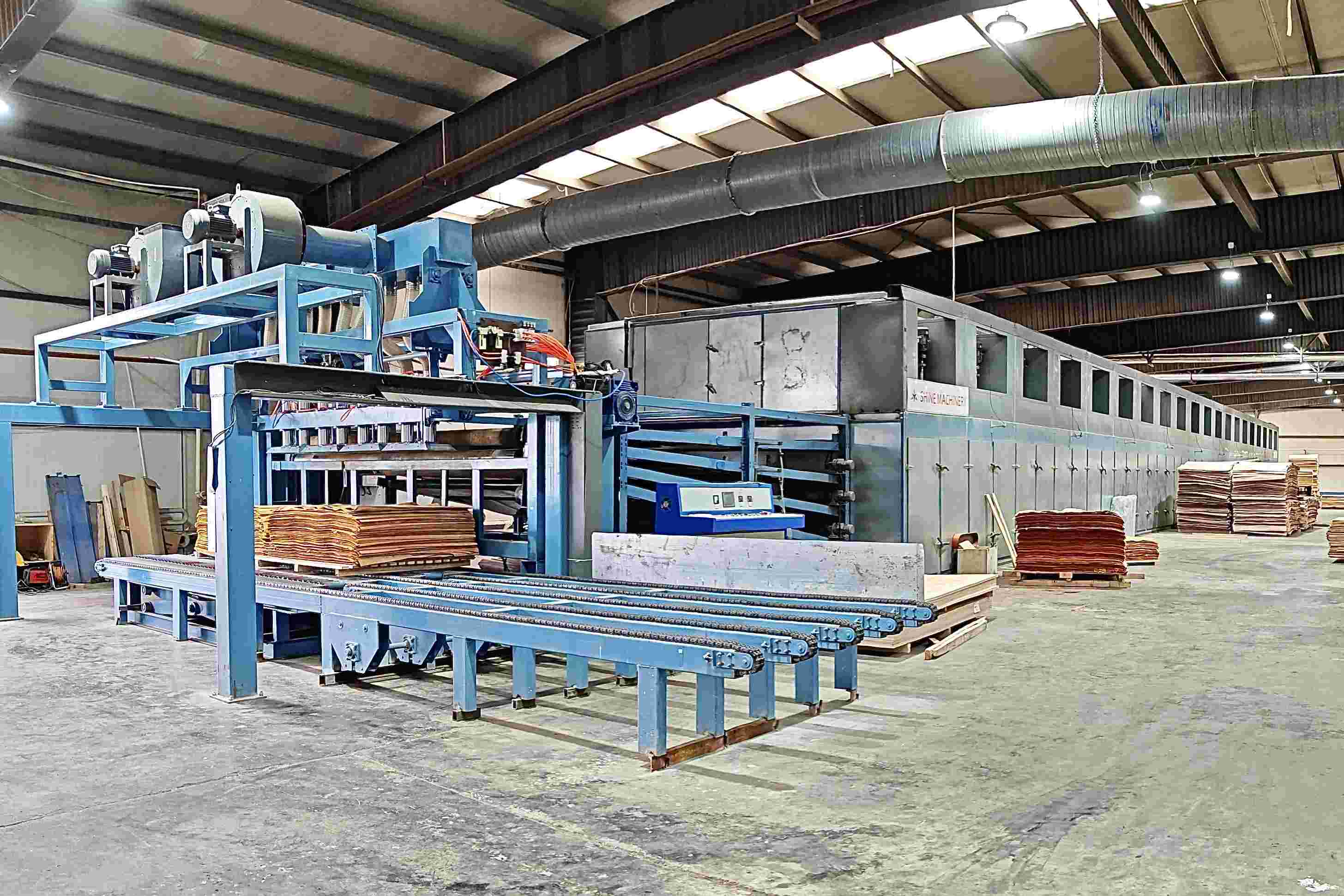
Intelligent control systems have emerged as a game-changer in optimizing thermal efficiency. Variable frequency drives (VFDs) on circulation fans and conveyor chains allow the machine to automatically adjust speed according to the actual load, saving 20% to 30% of electrical energy. Zoned temperature control divides the dryer into preheating, main drying, and balancing sections, each with independent setpoints. This prevents the common problem of over-drying the veneer surface while the core remains moist. Humidity sensors linked to exhaust fans ensure that damp air is expelled only when necessary, retaining heat inside the chamber. Advanced systems even include predictive maintenance alerts that detect abnormal temperature rises on the insulation panels, signaling potential insulation failure before it becomes a major energy leak. For plywood producers, these smart features translate into consistent product quality, lower operating costs, and a faster return on investment.
The economic impact of improving thermal efficiency is substantial. Industry benchmarks suggest that a typical veneer drying machine operates at 40% to 50% thermal efficiency. By implementing comprehensive upgrades—better insulation, optimized airflow, clean heat exchangers, proper operational practices, and intelligent controls—this figure can rise to 65% to 75%. For a medium-sized plywood mill, the difference represents thousands of dollars in annual fuel savings, not to mention reduced carbon emissions and improved product grade. In an era where global buyers increasingly demand sustainable manufacturing practices, demonstrating low energy consumption per ton of veneer produced can also become a competitive advantage in international tenders.
In conclusion, maximizing the thermal efficiency of a veneer dryer requires a holistic approach that addresses insulation integrity, airflow uniformity, combustion performance, operational discipline, and automation. Manufacturers who invest in these areas will find that the savings in fuel costs alone often pay back the upgrade investment within a year or two. More importantly, they will produce higher-quality veneer with fewer defects, strengthening their reputation in the global wood products market. As technology continues to evolve, the integration of smart sensors and energy recovery systems will further push the boundaries of what a modern veneer making machine can achieve. For any wood processing enterprise serious about profitability and sustainability, the question is no longer whether to optimize thermal efficiency, but how quickly they can implement the changes. The answer begins with a thorough audit of the existing dryer and a commitment to continuous improvement.